Hello! I’m Torimune, and I’ve been doing home workouts for 8 years.
When looking for home workout equipment, the most common candidates are dumbbells and resistance bands.
Resistance bands are inexpensive and take up almost no storage space.
Dumbbells have a certain price and weight, which can make them seem a bit intimidating for beginners.
“Aren’t bands enough to start with?”
“Can’t I wait to get dumbbells until I’m sure I can stick with working out?”
I think many people feel this way.
I myself bought resistance bands when I started home training to add resistance to my bodyweight exercises.
I was able to perform various exercises like arm curls, side raises, and rowing.
However, after a while, the opportunities to use the bands decreased, and eventually, I stopped using them almost entirely.
To put it simply, if you want to build muscle and change your body over the medium to long term, I recommend dumbbells.
You can build muscle with bands, too.
However, if you prioritize muscle growth and want to choose a primary tool that allows you to increase the load over several years, I feel that dumbbells are overwhelmingly easier to use.
In a nutshell,
resistance bands are “tools for starting exercise easily.”
dumbbells are “tools for continuing to grow muscle.”
In this article, based on my experience using both, I will explain the differences between dumbbells and resistance bands, why I stopped using bands, and who each is suited for.
Comparing the differences between dumbbells and resistance bands
I have summarized the differences between the two in a table.
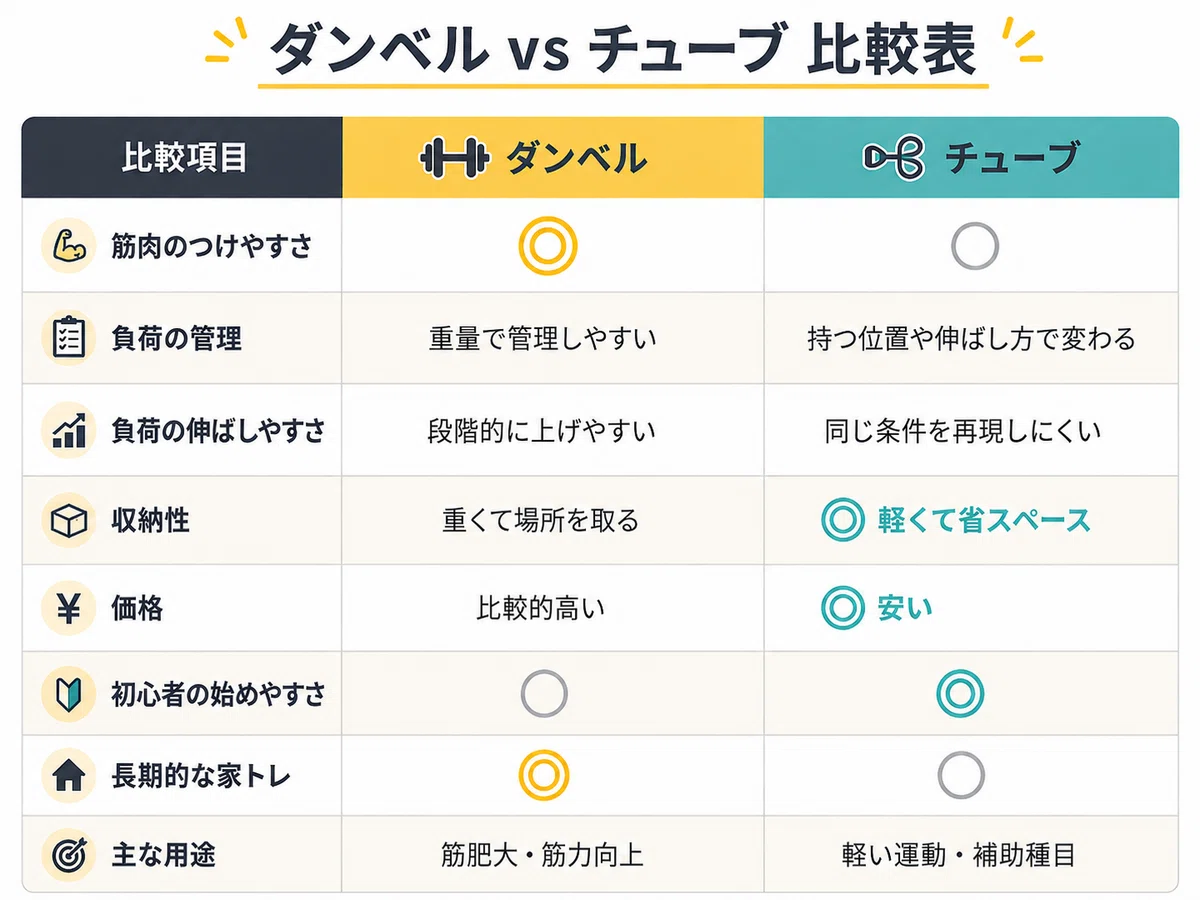
The strength of resistance bands is their price and convenience.
The strength of dumbbells is that you can record how many kilograms you lifted for how many reps, and it is easy to increase the load in line with your muscle growth.
For those who want to keep growing their muscles, this difference is quite significant.
The reason I bought resistance bands
A few months after I started working out at home, I felt that bodyweight training alone wasn’t providing enough resistance.
I wanted to add a bit more load to exercises like push-ups.
However, at the time, I didn’t have the courage to buy adjustable dumbbells that cost tens of thousands of yen.
That’s when I picked up resistance bands.
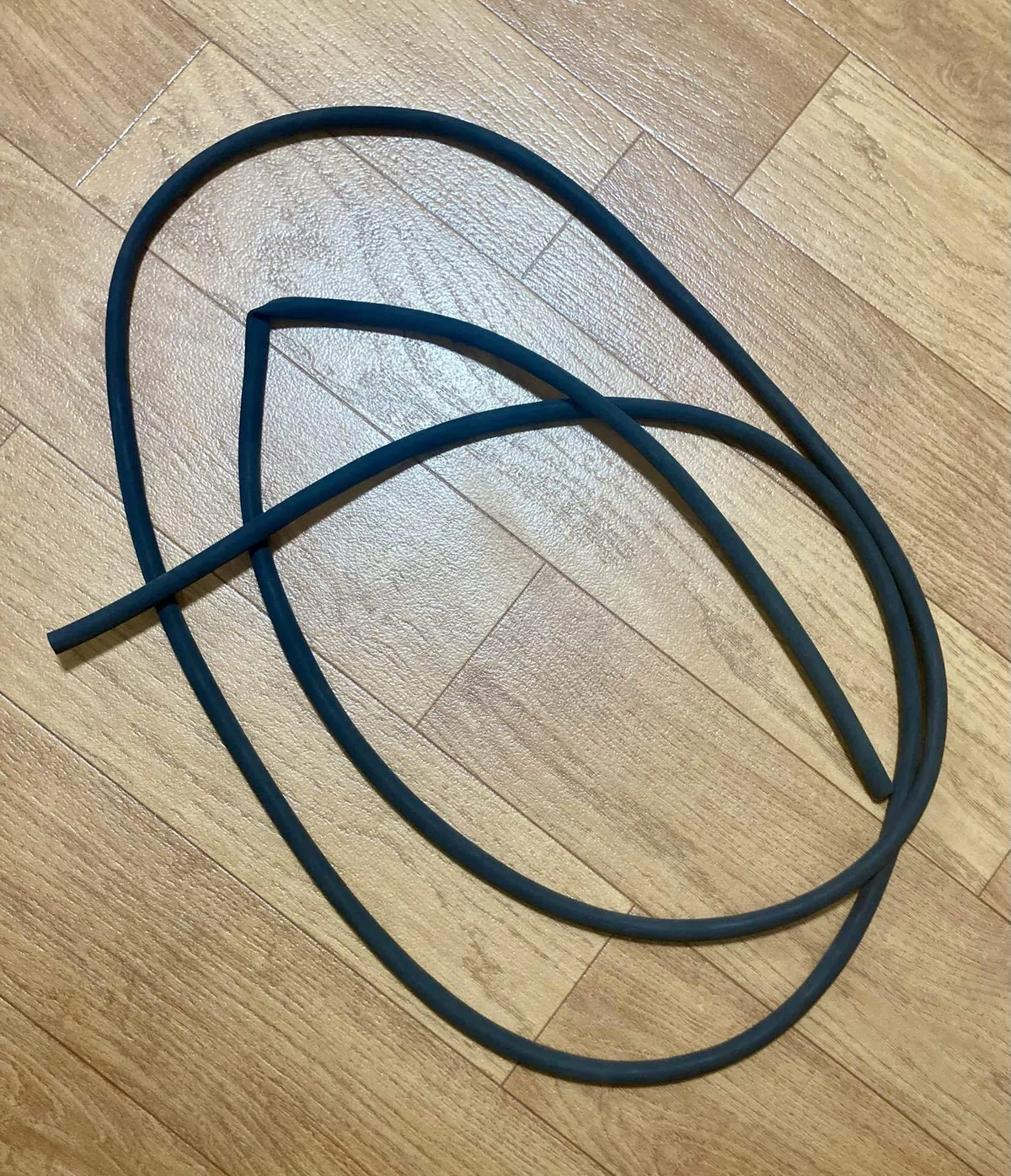
The model I actually purchased was this black one.
They were cheaper than dumbbells and could be rolled up and stored compactly. This convenience was very appealing to me at the time.
In fact, you can do a variety of exercises with bands.
The variety of exercises increased, and I felt more resistance in my muscles than when I was only doing bodyweight training.
However, as my strength increased, I began to find it difficult to continue using them as my primary equipment.
4 reasons why I stopped using resistance bands
The resistance became insufficient as my strength grew
The resistance of the bands, which felt sufficient at first, gradually became less satisfying as my strength improved.
In particular, I found it easy to feel a lack of resistance in exercises that target large muscle groups like the chest and back.
Of course, you can push your muscles by increasing the number of repetitions.
However, as you increase the reps to 20 or 30, your training time also gets longer. There is also the disadvantage that you get out of breath before your muscles are exhausted, making it difficult to continue the movement itself.
For me, wanting to efficiently load my muscles in a limited amount of time, it became difficult to continue using bands as my main equipment.
It was difficult to manage the load under the same conditions
To grow muscle, you need to gradually increase the weight or repetitions from the previous session and continuously increase the load.
With dumbbells, you can say things like,
“Last time was 20kg for 8 reps,”
“This time is 20kg for 9 reps,”
“Next time I’ll try 22kg.”
In this way, you can record the weight used and the number of repetitions with numbers.
On the other hand, with resistance bands, the load changes depending on where you hold them, where you step on them, how you stretch them, and the tension at the start.
Even if you intend to hold them at the same length as last time, a difference of just a few centimeters can change the feel.
What is important is not just whether you can create a strong load.
It is important to be able to reproduce the same conditions as last time and gradually increase the load from there. is what matters.
In that respect, I felt that dumbbells with clear weights were overwhelmingly easier to manage.
Holding them shorter made the movement cramped
To increase the load, you need to hold the band shorter.
However, if you hold it too short, the “slack” before the movement disappears.
The band is pulled tight from the starting position, making it difficult to maintain a natural posture. Depending on the exercise, the range of motion becomes narrower and the movement becomes awkward.
A weak band doesn’t provide enough load. But if you pull it tight, your starting posture and range of motion are easily compromised.
This difficulty in adjustment is also the reason why I moved away from resistance bands.
I didn’t feel the joy of challenging myself with weight
This is a very personal story.
I am the type of person whose training motivation increases with equipment that has clear weights, like dumbbells.
“Lift one more rep than last time,”
“Increase the weight by one level next time.”
When goals are clearly defined by numbers like this, it becomes easier to feel your progress.
The sense of accomplishment when I managed to lift that final rep to failure also became motivation for my next workout.
Resistance bands have the advantage of providing constant tension throughout the movement, but in my case, the joy of challenging myself with weight became the driving force that kept me doing home workouts for a long time.
Can high-resistance bands solve the issue of insufficient load?
Some of you might think, “Why not just use higher-resistance bands?”
In fact, there are bands on the market with higher resistance than the ones I used. There are also products that allow you to combine multiple bands to increase the load.
So, I don’t intend to say that you can’t create a strong load with bands.
However, as the resistance increases, the bands become stiffer, making it harder to get into the starting position.
Depending on the exercise, there is also a sensation where the load is weak in the first half of the movement and suddenly becomes heavy only in the second half.
Also, it takes time and effort to adjust the appropriate length for each exercise and reproduce the same conditions every time.
Being able to create a strong load and being able to manage that load consistently are two different things.
High-resistance bands are convenient for people who cannot store dumbbells or who want to train while on business trips.
However, if you have the space to keep equipment at home and are choosing one primary tool for building muscle, I would still choose dumbbells.
Why dumbbells are suitable for those who want to build muscle
You can manage weight and reps with numbers
With dumbbells, it is clear how many kilograms you lifted and how many times. It is easy to compare with your previous records and determine if your strength is increasing.
In home workouts, there is no one to decide the weight for you. That is precisely why choosing equipment that is easy to track yourself leads to continuous growth.
You can increase the load according to your strength
With adjustable dumbbells, you can start with a light weight and gradually increase it as your strength grows.
You can use a light weight for side raises, and a heavy weight for presses and rowing to train your chest and back.
In this way, you can change the load according to the exercise and your strength.
Can be used for almost full-body training
With dumbbells and a bench, you can perform a wide variety of exercises.
-
Dumbbell Press
-
Dumbbell Fly
-
One-Arm Row
-
Shoulder Press
-
Side Lateral Raise
-
Arm Curl
-
Lying Extension
-
Bulgarian Split Squat
-
Romanian Deadlift
You can train almost your entire body, including your chest, back, shoulders, arms, and legs.
While resistance bands also offer many exercises, dumbbells have a significant advantage as a primary tool for long-term use while tracking your load.
Who are dumbbells for? Who are resistance bands for?
Dumbbells are recommended for the following people:
-
Those who want to build muscle
-
Those who want to train their body until they see a visible change
-
Those who want to continue home training in the medium to long term
-
Those who want to track their strength growth with numbers
-
Those who want to train their whole body seriously
-
You want to challenge yourself with heavy weights in the future
On the other hand, resistance bands have their own advantages.
-
You want to start with light exercise
-
You are not yet confident in your strength
-
You want to prioritize storage space
-
You want to use them for warm-ups or auxiliary exercises
-
You don’t have space to store dumbbells
-
You want to exercise while traveling
If you are serious about building muscle, choose dumbbells.
If you want to start light exercise or need auxiliary equipment, choose resistance bands.
Thinking about it in terms of your goals like this makes it easier to choose.
A 24kg adjustable dumbbell is recommended for your first pair
For beginners who are about to buy dumbbells, a 24kg adjustable dumbbell is recommended.
Fixed-weight dumbbells cannot have their weight changed even as your strength increases. Even with adjustable ones, a 10kg set might feel insufficient relatively quickly for exercises that train your chest or back.
While 40kg models can be used for a long time, they are expensive and the units themselves are large. It is a fact that they are a bit of a high hurdle for those just starting home workouts.
In that regard, 24kg adjustable dumbbells offer an excellent balance of price, size, and weight.
They can handle a wide range of exercises, from light side raises to dumbbell presses, one-arm rows, and Bulgarian split squats.
Even if I were to choose my first dumbbell again from scratch, I would start with a 24kg adjustable model.
In particular, types that allow you to change the weight just by turning the grip are great for home workouts because they eliminate the hassle of swapping plates.
Among the dumbbells currently available, this is the model I can confidently recommend to you all👇
For 24kg adjustable dumbbells, I have summarized the details on how to choose the weight and my recommended models in this article.
If you are wondering,
“Is 24kg enough for me?” or “Should I buy 40kg from the start?”
please be sure to read it.
Summary | Resistance bands aren’t bad. But for building muscle, choose dumbbells.
Resistance bands are excellent tools that are inexpensive, space-saving, and easy to start exercising with. They can also be used for warm-ups and auxiliary exercises.
However, to keep building muscle, you need to manage the load under the same conditions and increase it little by little.
In that regard, dumbbells, which allow you to record weight and repetitions as numbers, are more suitable.
Use resistance bands for light exercise or auxiliary purposes.
Use dumbbells if you want to build muscle and change your body over the medium to long term.
This is my conclusion after using both.
For those who are unsure about their first pair of dumbbells, I recommend adjustable dumbbells up to 24kg. This is because they are hard to outgrow even as your strength increases, and they can be used for a long time by both beginners and intermediate users.
Just buying equipment won’t change your body.
Even so, having equipment on hand that allows you to increase the load as you grow will be a great help in continuing your home workouts.
If you are serious about changing your current body, try choosing equipment that will support your growth for years to come.
Thank you for reading to the end this time as well!
✳️ For those who want to make their home workouts even more fulfilling
▶ Dumbbell Article Summary
With 8 years of home workout experience, I have summarized how to choose and use dumbbells, weight selection, recommended products, and comparison reviews based on my actual experience.
This is recommended for those who are wondering, “How many kg should I choose?”, “Which is better, adjustable or fixed?”, or “Which dumbbell suits me?”, as well as those who want to choose the right one for themselves without regrets.
▶ Top 10 Strength Training Equipment I’m Really Glad I Bought
Based on my 8 years of home workout experience, I introduce only the items I truly felt were worth buying out of the many strength training tools available, in a ranking format.
If you want to equip yourself with home workout gear other than dumbbells, or if you are wondering what to buy next, please use this as a reference.
▶ For those who are serious about changing their body with home workouts
I have compiled everything I learned while transforming my body through years of home training into a complete guide to help beginners avoid taking the long way around.
This is a definitive guide that consolidates all the information you need to change your body through home training, including diet, the order of equipment selection, training methods, and the mindset required for consistency.
If you are wondering where to start or want to avoid wasting time, please take a look here.
Note: This article contains Amazon Associate links. As an Amazon Associate, Torimune earns from qualifying purchases. The products introduced are those I have actually used myself or those I truly feel are recommended after years of continuing home training.