You’re losing strength, not just weight: Why muscle quality matters more than size and how to protect it to prevent early metabolic disease |



Weight loss is often celebrated. Clothes fit better, the number on the scale drops, and compliments follow. But there is another side that rarely gets attention. Some people lose weight and feel weaker, slower, and more tired than before.That uneasy feeling is not imagined. It often points to something deeper: the body may be losing strength, not just fat. And in many cases, this quiet shift can hint at early metabolic trouble, long before routine tests raise alarms.
The hidden difference: Muscle quality vs muscle size
Muscle is not just about how it looks. Two people can have the same muscle size but very different muscle quality. One may feel strong and energetic, while the other struggles with fatigue.Muscle quality refers to how well the muscle functions. It includes strength, endurance, and how efficiently the muscle uses energy. When muscle quality drops, the body becomes less efficient at handling glucose and fats.As Dr Mriganka S Sharma explains, “Losing weight is considered a blessing; however, clinically speaking, not all cases of weight loss are necessarily beneficial for the patient’s well-being.”This is where confusion begins. The scale shows progress, but the body feels weaker. That gap is often the first warning.

This loss of strength can signal early metabolic issues, even before blood tests show abnormalities.
Why muscle matters more than you think
Muscle is one of the most metabolically active tissues in the body. It plays a direct role in controlling blood sugar levels and insulin response.When muscle quality declines, the body struggles to process glucose properly. Over time, this can increase the risk of conditions like insulin resistance and early metabolic disease.According to the National Institutes of Health, reduced muscle strength and function are strongly linked to poor metabolic health, even in people who appear to have a normal body weight.Another report by the Frontiers in Endocrinology highlights how muscle health influences glucose metabolism and long-term disease risk.These findings make one thing clear: muscle is not just for movement. It is central to how the body manages energy.
The early signs people tend to ignore
The body often sends signals, but they are easy to dismiss. Feeling tired after simple tasks. Struggling to carry groceries. Taking longer to recover after mild activity.These changes do not feel dramatic, so they rarely trigger concern.Dr Amit D Goswami puts it simply: “A muscle tissue is a highly metabolic one, and its function is essential in regulating glucose metabolism, insulin sensitivity, and the whole body metabolism.”This means even small drops in muscle performance can have wider effects. Strength loss may show up years before blood sugar levels cross into danger zones.
How modern lifestyles quietly worsen muscle quality
Sedentary routines have become the norm. Long hours at desks, minimal movement, and irregular eating patterns slowly affect muscle health.Crash diets and prolonged fasting add another layer. They may reduce weight quickly, but often at the cost of muscle tissue. The body loses strength while appearing slimmer.Over time, this creates a paradox. The body looks lighter but functions worse.As the doctors note, “It becomes particularly evident in a case of people with a sedentary lifestyle or the history of fasting diets, when the person tends to lose a lot of muscles.”
Shifting the focus: From weight loss to muscle health
The conversation needs a reset. Instead of asking “How much weight was lost?”, the better question is “How strong does the body feel?”Improving muscle quality does not require extreme measures. It starts with consistent habits:
- Regular resistance exercises, even light ones
- Balanced meals with adequate protein
- Avoiding extreme calorie cuts
- Staying physically active through the day
The idea is simple but often overlooked. Protect muscle, and the body protects itself.As the doctors emphasise, “We should move from reducing weight to promoting muscle health.”
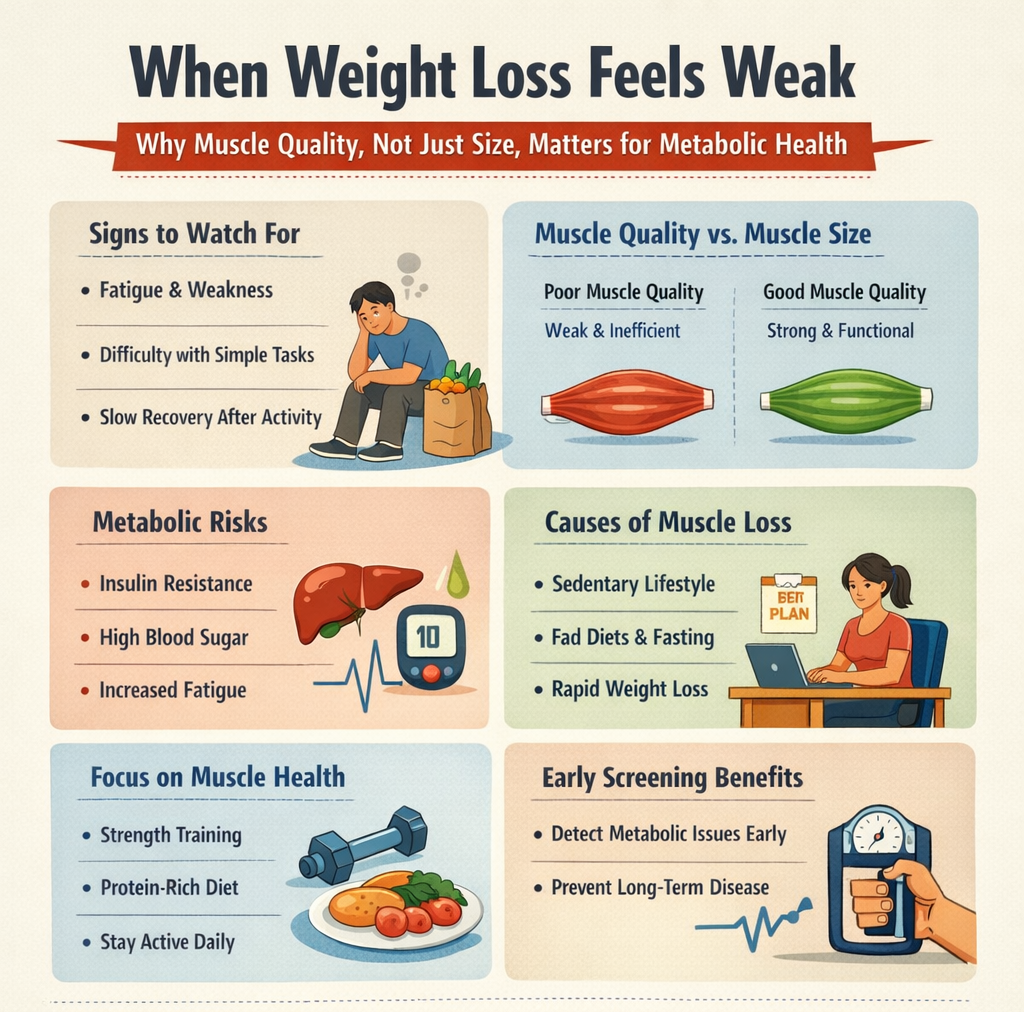
Focusing on muscle health, not just weight, can help prevent long-term disease and improve overall well-being.
Why early screening could change everything
Routine health checks focus on blood sugar and cholesterol. But by the time these numbers shift, metabolic changes may already be underway.Measuring muscle strength and function can offer earlier clues. Simple tests like grip strength or walking speed can reveal more than expected.The doctors highlight this shift clearly: “Early screening of muscle mass and muscle strength might become an important aspect of the prevention of metabolic disorders.”This approach moves healthcare from reaction to prevention.
Strength is the real signal
In this context, strength is not about lifting heavy weights. It is about how well the body functions every day.Weight loss can be helpful. But if it comes with weakness, it deserves a second look. Because sometimes, the body is not getting healthier. It is quietly losing its edge.Medical experts consultedThis article includes expert inputs shared with TOI Health by:Dr Mriganka S Sharma (Director – General & Minimally Invasive Surgery), CK Birla Hospital, Gurugram.Dr Amit D Goswami (Associate Director – General & Minimally Invasive Surgery), CK Birla Hospital, Gurugram.Inputs were used to explain how a decline in muscle quality, not just weight loss, can signal early metabolic disease, highlight subtle warning signs often overlooked, and emphasise the importance of timely evaluation along with targeted lifestyle changes to improve metabolic health.