Is ’10 reps x 3 sets’ the correct way to strength train? A doctor investigates the ideal number of reps and sets|かず|医師が試す健康の話

# Is ’10 reps x 3 sets’ the correct way to strength train? A doctor investigates the ideal number of reps and sets
When you start strength training, there is a number you will encounter with high probability.
’10 reps x 3 sets’
Even on gym machines,
Aim for 10 reps.
is sometimes written.
When I strength train, I also
‘I guess I’ll just do 3 sets of 10 reps’
sometimes think.
But a question suddenly arises.
Is 5 reps not enough?
Is 15 reps too many?
And,
is there no point in doing 1 set instead of 3?
This time,
‘Is 10 reps x 3 sets the correct answer for strength training?’
I will organize this based on research.
## Conclusion first
To give the conclusion first,
’10 reps x 3 sets is the only correct answer’
is not the case.
Summarizing current research roughly,
・Muscle hypertrophy can occur across a fairly wide range of reps and weights
・Muscle hypertrophy can be expected even with light weights if performed with sufficient effort
・On the other hand, heavy weights are advantageous for increasing maximum strength
・Even 1 set is not ‘zero’
・However, multiple sets tend to be more advantageous for muscle hypertrophy
・The number of sets does not mean the effect increases infinitely the more you do
is how it feels.
In other words,
’10 reps x 3 sets’
is an easy-to-use setting, but
it is not an absolute rule.
## ① What is ’10 reps’ in the first place?
First,
’10 reps’
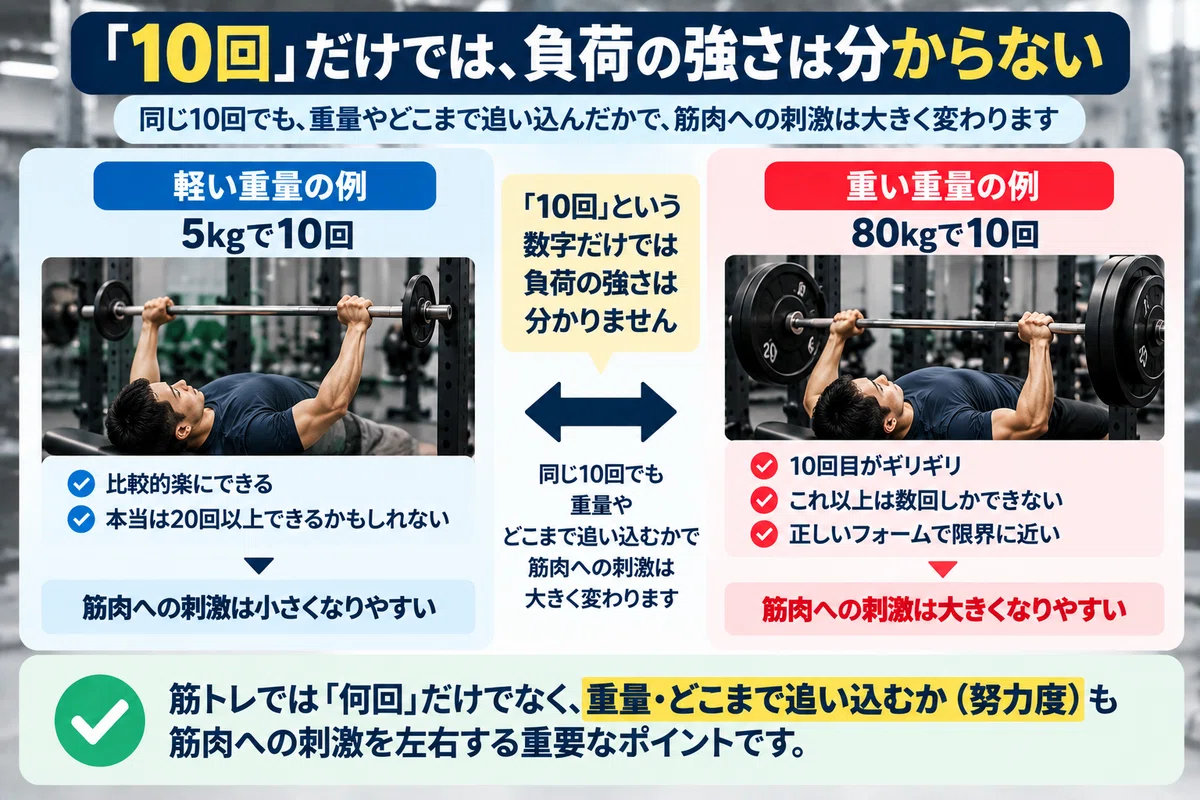
with just this number, you actually cannot tell the intensity of the load.
For example, for arm curls,
someone doing 10 reps with 5kg,
and someone doing 10 reps with 15kg.
Even with the same 10 reps, the load is completely different.
Furthermore,
stopping at 10 reps with a weight you could actually do 20 reps with
and
the 10th rep being quite close to failure
are also different.
In strength training,
‘how many reps you did’
is not the only thing that matters; how much weight you used and how far you went to the point of fatigue are also important.
## ② Is ‘8-12 reps’ best for muscle hypertrophy?
Something often said for a long time is,
‘8-12 reps if you want to build muscle’
is the story.
Certainly, this range allows you to
handle a certain amount of weight,
and also complete a certain number of reps.
It is a very easy-to-use range in practice.
However,
‘only 8-12 reps is the zone where muscle hypertrophy occurs’
does not mean that.
## ③ Can muscles grow even with light weights?
In a meta-analysis published by Schoenfeld et al. in 2017,
low-load training and
high-load training are compared.
As a result,
regarding muscle hypertrophy, it occurred with both low and high loads,
and no clear difference was confirmed between the two.
In other words,
‘muscles won’t grow unless you use heavy weights’
cannot be said.
Even with relatively light weights,
if you perform the sets to a sufficient degree of effort,
muscle hypertrophy can be expected.
This is quite important.
Just because you went to the gym,
it does not mean you have to lift extremely heavy weights every time.
## ④ So is 30 reps with light weight okay?
This requires a little caution.
In research,
it is shown that muscle hypertrophy occurs even with relatively light loads.
However, the lighter the weight,
in order to give the muscles sufficient stimulation,
a fairly large number of reps may be required.
For example,
stopping at 10 reps with a weight where ‘you still have room even after 30 reps’.
This may result in smaller stimulation.
On the other hand,
if you continue to 20, 25 reps,
and go until ‘I wonder if I can do a few more reps’,
the story changes.
In other words,
‘light weight is OK’
and
‘easy strength training is the same’
are different stories.
## ⑤ If you want to increase strength, the story changes
Up to this point, I have mainly talked about muscle hypertrophy.
Then,
I want to bench press 100kg.
I want to increase my maximum squat weight.
What about in cases like that?
In this case,
training that handles heavy weights is more advantageous.
In the meta-analysis mentioned earlier,
while no clear difference was confirmed between low and high loads for muscle hypertrophy,
high-load training was advantageous for improving maximum strength.
This is natural when you think about it.
If you want to improve your ability to lift heavy things,
practicing with actual heavy weights is also important.
That is what it means.
## ⑥ So how many reps should I do?
Reading this far,
I think you will be wondering, ‘So how many reps should I do in the end?’
If muscle hypertrophy is the goal,
you do not necessarily have to fix it at 10 reps.
In practice,
I think it is easy to handle if you center it around 6-15 reps.
For example,
Bench press 6-10 reps
Seated row 8-12 reps
Leg press 8-15 reps
Arm curl 10-15 reps
is how it feels.
However,
this number does not mean it is the medical ‘correct answer’.
In research, muscle hypertrophy can occur with an even wider range of loads and reps.
6-15 reps is,
you can handle a certain amount of weight,
1 set does not become too long,
and the number of reps is easy to manage.
It is a practical guideline.
## ⑦ Is it necessary to ‘do it to the limit’?
This is also something often heard in strength training.
‘If you want to build muscle, push yourself to the limit every set’
is the story.
But,
it is not necessarily the case that you have to do it until you completely stop moving every set.
In recent research,
it is considered important for muscle hypertrophy ‘how close to the limit you went’,
but it cannot be said that you must always perform to the absolute limit every set.
For example,
stop at a point where ‘I think I could do about 1-3 more reps’.
So-called,
RIR (Repetitions In Reserve)
= how many more reps could I have done
is the way of thinking.
If RIR 2,
it means ‘I could have done about 2 more reps’.
Especially for beginners,
rather than pushing to the limit every set until your form breaks down,
perform until it is somewhat difficult while maintaining correct form.
I think it is fine to start from there.
## ⑧ Then is ‘3 sets’ the correct answer?
Next is the number of sets.
What is common is,
10 reps x 3 sets.
Then,
does 3 sets have a special scientific meaning?
As a conclusion,
‘always 3 sets’
is not the case.
## ⑨ Is there no point in 1 set?
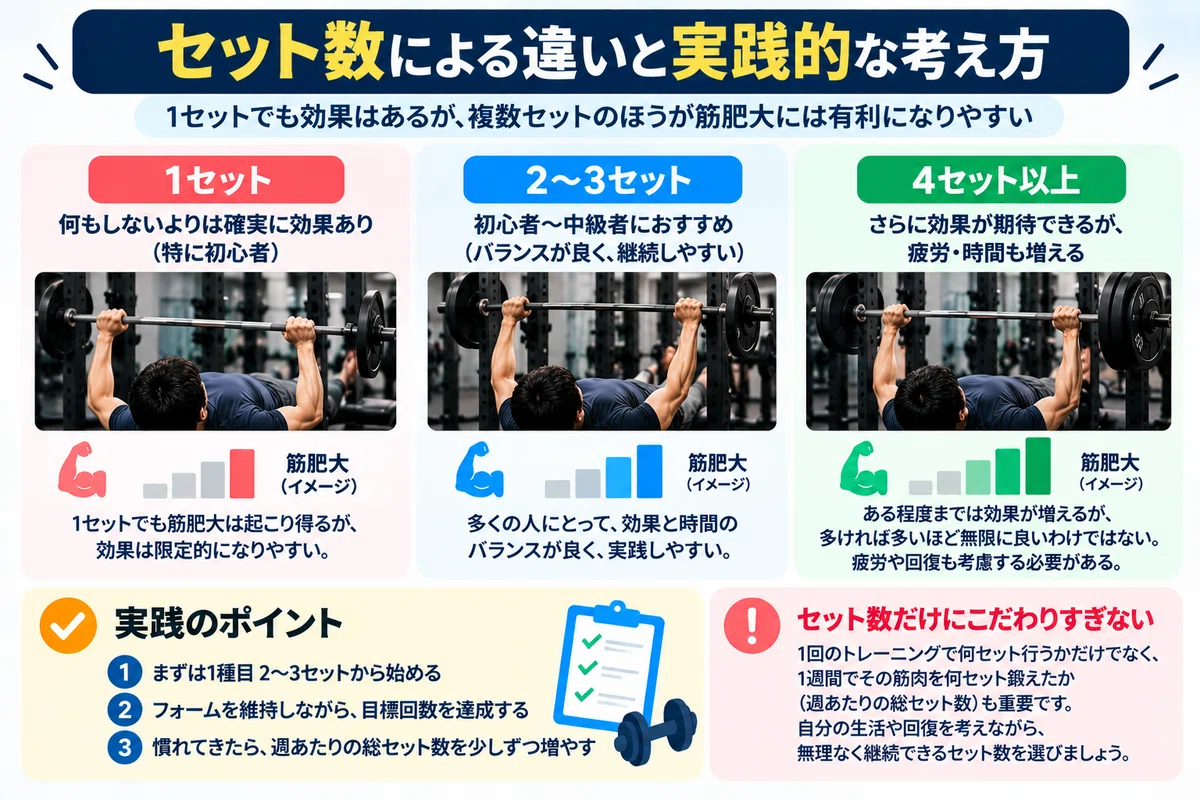
It is not that there is no point in 1 set.
Especially,
a person who has not done strength training until now,
does 1 set a few times a week.
This is,
naturally a bigger step than doing nothing.
On the other hand,
when aiming for muscle hypertrophy,
there is research that ‘multiple sets are more advantageous than 1 set’.
In a 2010 meta-analysis,
when comparing 1 set and multiple sets,
it was shown that multiple sets are more advantageous for muscle hypertrophy.
In other words,
it is not ‘zero with 1 set’,
but if you want to increase muscle properly,
it seems there is a point in increasing the number of sets to some extent.
## ⑩ Is more sets better?
Then,
5 sets instead of 3 sets.
10 sets instead of 5 sets.
20 sets instead of 10 sets.
Will muscles grow larger the more you increase them?
Of course, it is not that simple.
If you increase the number of sets,
the training volume increases.
However, at the same time,
fatigue also increases.
It also takes time.
It also affects recovery.
You can expect the merit of increasing training volume up to a certain point, but
‘the more the better infinitely’
is not the case.
## ⑪ Don’t just think about ‘how many sets in one strength training session’
When thinking about the number of sets,
rather than looking at just one training session,
the way of thinking of ‘how many sets did you train that muscle in one week’
is also important.
For example, for the chest,
3 sets on Monday
3 sets on Thursday
then,
6 sets per week.
Even if you do 6 sets only on Monday,
it is 6 sets per week.
Of course, it is not necessarily the case that these two are completely the same.
However,
not just ‘definitely 3 sets today’,
it becomes easier to manage if you look at how much you are training in the whole week.
## ⑫ What should a beginner do?
If you have just started strength training,
I think you don’t need to think too much about the details from the beginning.
For me,
per exercise
8-12 reps around x 2-3 sets
I would start from about there.
And,
can maintain form
↓
can stably do the target reps
↓
increase weight little by little
I would make it a flow like that.
For example,
bench press,
50kg
10 reps
10 reps
10 reps
became able to do.
Moreover,
if it feels like ‘I think I could do many more reps’,
next time I will try increasing the weight a little.
Conversely,
10 reps
6 reps
3 reps
if it drops rapidly,
not just the weight,
I will also review the rest time introduced in the previous article.
It is enough to adjust like this.
## ⑬ I also use ’10 reps x 3 sets’ myself
Up to this point,
I have written that ’10 reps x 3 sets is not the correct answer’.
However,
I also normally strength train around 10 reps x 3 sets myself.
Because,
it is incredibly easy to manage.
I did 10 reps.
I did 10 reps next time too.
Let’s increase the weight a little next time.
Like that,
progress is easy to understand.
In other words,
’10 reps x 3 sets’ is not a mistake, but
one of the very easy-to-use methods.
However,
‘anything other than 10 reps x 3 sets is meaningless’
is not the case.
That is what it means.
## ⑭ In the end, how many reps x how many sets should I do?
Finally,
for those who are thinking, ‘I understand the logic, so what should I do from tomorrow?’
I will summarize.
If you are a strength training beginner,
and want to build muscle/tone your body,
first,
start from about 1 exercise 8-12 reps around x 2-3 sets.
I think this is enough.
Once you get used to it,
weight
reps
number of sets
training volume per week
adjust little by little.
From the beginning,
you don’t need to worry too much about ‘is the optimal number of reps 8, 10, or 12’.
Muscles will grow even with 8 reps.
They will grow with 10 reps.
They will grow with 12 reps.
Even with more reps, muscle hypertrophy occurs depending on the conditions.
What is important is,
to apply a load firmly to some extent,
to advance training little by little,
and to continue it.
## Summary
‘Strength training is 10 reps x 3 sets’
this is,
not a mistake.
Rather, for beginners,
it is a fairly easy-to-use method.
However,
neither the number 10 reps,
nor the number 3 sets,
has a special boundary line that says ‘only here is the correct answer for muscle growth’.
Summarizing the points this time,
・Muscle hypertrophy can occur with a wide range of weights and reps
・Muscle hypertrophy can be expected even with light weights if the degree of effort is sufficient
・Heavy weights are advantageous for increasing maximum strength
・It is not necessarily the case that you must perform to the absolute limit every set
・1 set is not meaningless
・Multiple sets tend to be more advantageous for muscle hypertrophy
・Think about the number of sets not just for 1 session but for the whole week
・For beginners, 8-12 reps around x 2-3 sets is easy to start
is how it feels.
In the end,
rather than ‘did I keep to 10 reps x 3 sets’,
I became able to handle slightly heavier weights than last month.
I became able to do 1 more rep with the same weight.
I was able to continue strength training for 3 months.
These kinds of changes are more important.
For strength training too,
don’t try to make a 100-point program from the beginning,
start from about 70-80 points that you can continue.
That might be just right.
※This article is intended for general health and exercise information, and is not intended for individual diagnosis, treatment, or exercise prescription. If you have an underlying illness or exercise restrictions, please consult a professional such as a doctor.
【References】
1. Schoenfeld BJ, Grgic J, Ogborn D, Krieger JW.
Strength and Hypertrophy Adaptations Between Low- vs. High-Load Resistance Training: A Systematic Review and Meta-analysis.
J Strength Cond Res. 2017;31(12):3508-3523.
doi:10.1519/JSC.0000000000002200
2. Krieger JW.
Single vs. multiple sets of resistance exercise for muscle hypertrophy: a meta-analysis.
J Strength Cond Res. 2010;24(4):1150-1159.
doi:10.1519/JSC.0b013e3181d4d436
3. Schoenfeld BJ, Ogborn D, Krieger JW.
Dose-response relationship between weekly resistance training volume and increases in muscle mass: A systematic review and meta-analysis.
J Sports Sci. 2017;35(11):1073-1082.
doi:10.1080/02640414.2016.1210197
4. Grgic J, Schoenfeld BJ, Orazem J, Sabol F.
Effects of resistance training performed to repetition failure or non-failure on muscular strength and hypertrophy: A systematic review and meta-analysis.
J Sport Health Sci. 2022;11(2):202-211.
doi:10.1016/j.jshs.2021.01.007