Do you have to do all your strength training at once? Can you build muscle by splitting it into three sessions a day?|庵野拓将

[Announcement of a new book release!]
People who split their strength training into three short sessions a day and those who did it all at once saw similar gains in muscle strength and endurance, with no significant difference between the two groups. Furthermore, a recent study from Tongji University found that those who split their sessions felt that the exercise was more enjoyable.
Strength training is widely recommended as a way to increase muscle strength and muscle mass. However, typical strength training often takes 30 to 60 minutes, including rest between sets. For people busy with school or work, “not being able to find a block of time” is a major reason they cannot continue.
That is why the concept of “exercise snacking” is gaining attention.
It is a method of performing short bouts of exercise several times throughout the day, much like snacking. However, previous research has focused mainly on aerobic exercise such as climbing stairs or brisk walking, and the effects of splitting strength training throughout the day were not well understood.
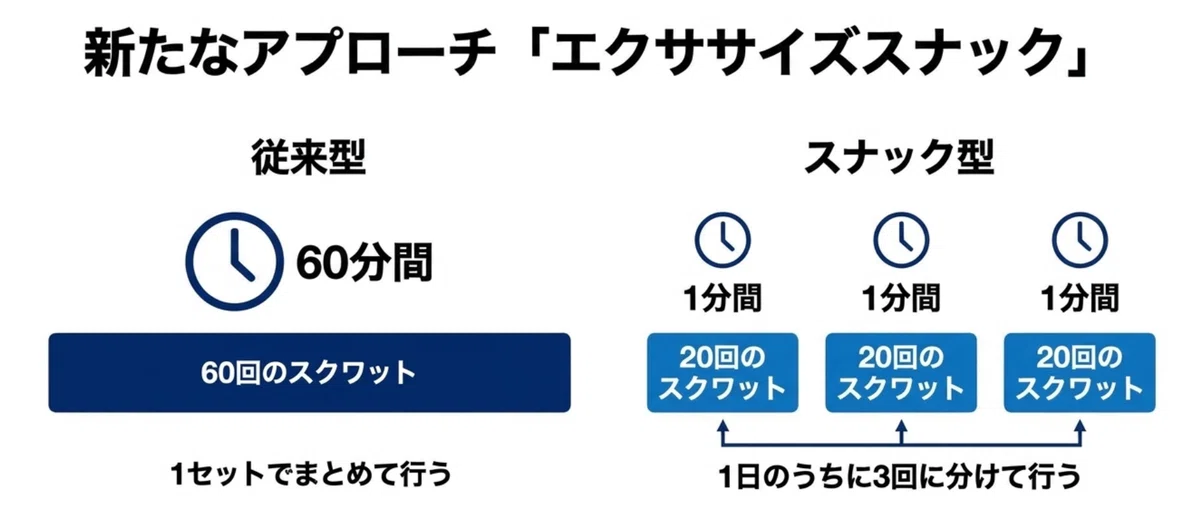
Therefore, in 2026, a research team at Tongji University conducted an 8-week experiment with 45 male college students aged 18-25 who had at least 6 months of strength training experience, dividing them into three groups.
-
Split group: 20 squats, 3 times a day, with at least one hour between sessions
-
Standard group: 20 squats x 3 sets, performed all at once with 3 minutes of rest in between
-
Comparison group: Did not perform the experimental training, but continued their daily life and regular strength training
The training was performed three times a week using a Smith machine, where the bar’s path is fixed. The weight started at 40% of their “one-rep max” and was increased to 55% for the final two weeks.
The key point here is that the total number of repetitions per day for both groups was the same at 60.To use a shopping analogy, the total amount is the same, and the only difference is whether you pay in a lump sum or in three installments.
As a result, the maximum weight increased from an average of about 81kg to 113kg in the split group, and from about 79kg to 120kg in the standard group, and both showed significant improvement over the comparison group. Muscle endurance also improved in both groups compared to the comparison group. Muscle endurance was measured by how many consecutive squats could be performed at 40% of the maximum weight at that time.
Looking only at the numbers, the standard group had slightly larger gains, but the difference between the two groups was not significant enough to be considered a clear distinction.
On the other hand, when asked to rate the enjoyment of the exercise on a 7-point scale, the split group scored about 5.9 points and the standard group about 5.5 points, meaning the split group felt it was more enjoyable. It is possible that the shorter duration of each session made it easier to get started. The research team believes that the environment, where the equipment was on the first floor of the dormitory and could be used without changing clothes, also had an impact.
Note that the subjects were only young men with strength training experience, and the exercise was limited to squats. It is not yet known if these results apply directly to women, the elderly, or people with no exercise experience.
In summary, if the total number of repetitions per day is the same, there was no significant difference in the gains in muscle strength and muscle endurance whether strength training was split into three sessions or done all at once. And, it was felt to be more enjoyable when done in split sessions.
For those who feel they “cannot do strength training because they don’t have a block of time,” trying to split a minute of squats into morning, noon, and night is one option. Even on days when you cannot find time, accumulating short bouts of exercise might be a way to keep up with strength training.
◆ References
Zhai R, et al. Fragmented versus traditional resistance training: a randomized controlled trial on muscular strength, endurance, and enjoyment in recreationally trained young adults. J Exerc Sci Fit. 2026 Sep 1.
◆ Introducing the magazine “Scientifically Correct Strength Training & Diet”! [First month free]
Since the publication of “Scientifically Correct Strength Training” and “Scientifically Correct Diet,” science has progressed even further.
In this magazine, we explain the “latest evidence you need to know now” regarding strength training and diet in an easy-to-understand way every week.
[Magazine Contents]
・Updated every Sunday (at least 4 articles per month)
・600 yen per month (first month free)
Recommended for trainers and trainees who want to “learn more scientifically” or “apply the latest research to their practice.”
The first month is free, so I would be happy if you could check it out!