I know I should do strength training. But I don’t know where to start. I’m worried about pushing myself too hard like I did when I was young and hurting something.
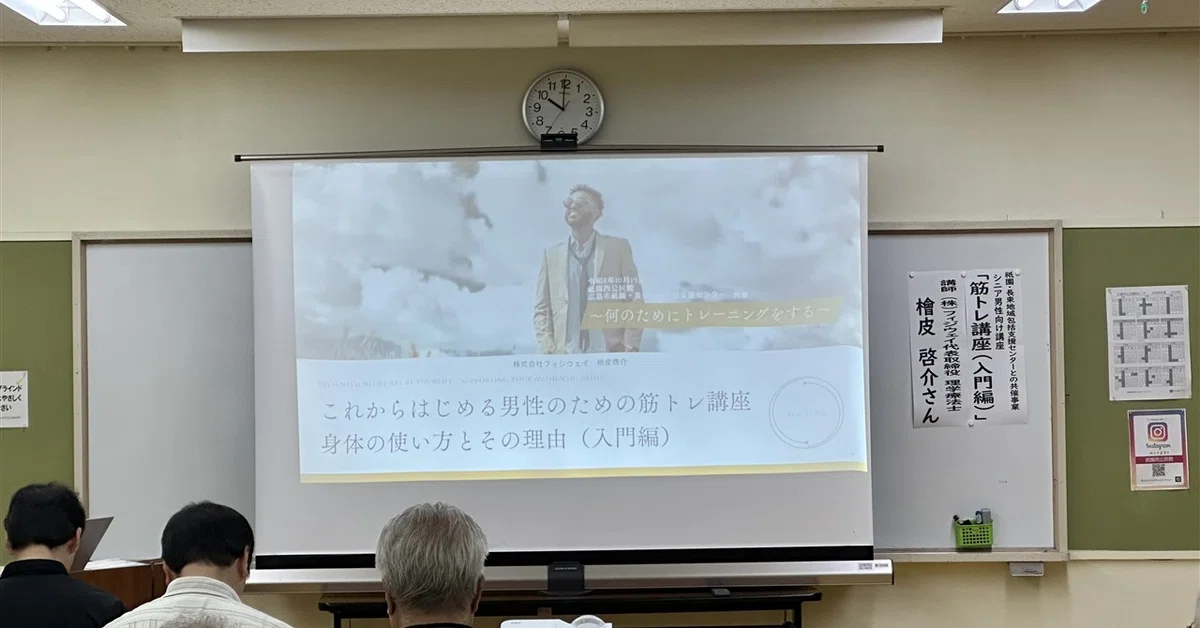
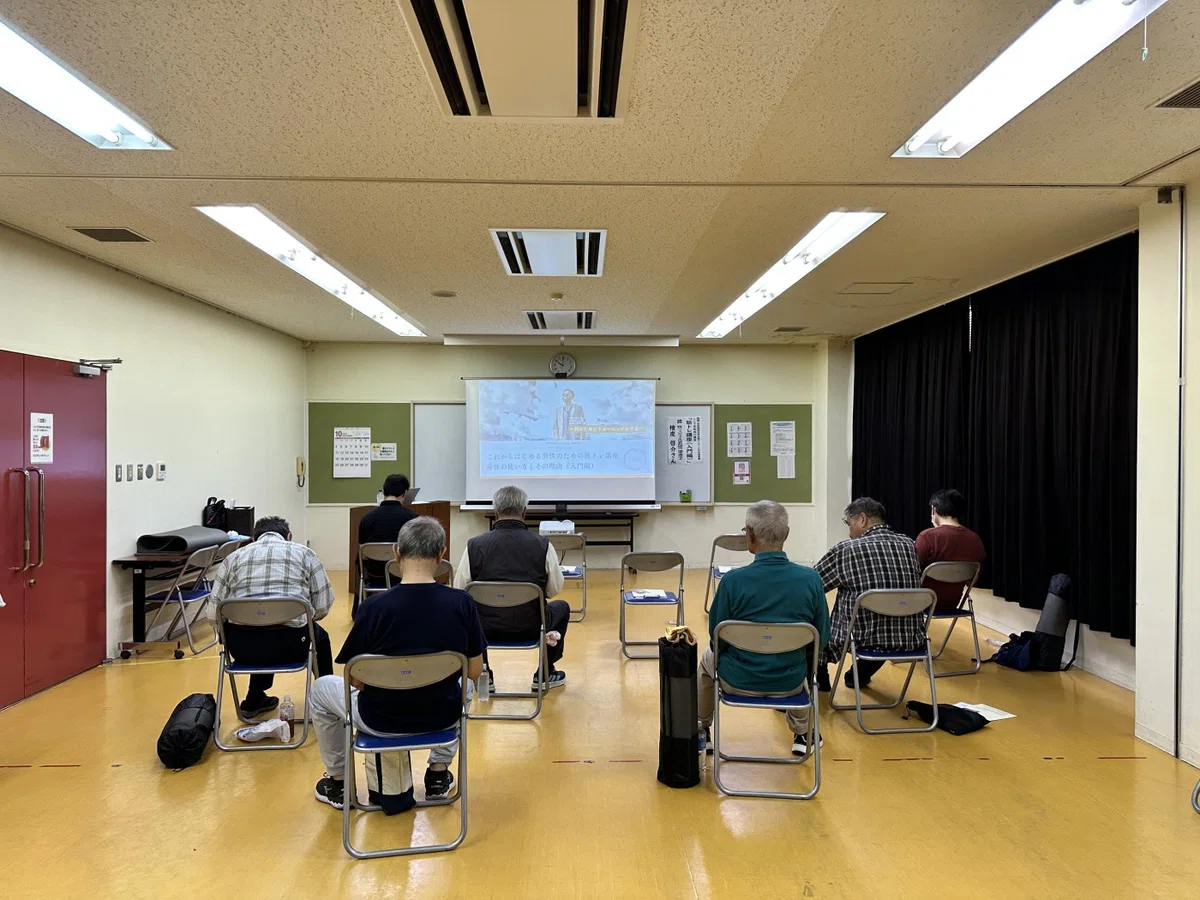
In response to such concerns, on Monday, October 19, Reiwa 8, we held the ‘Community Center Strength Training Course for Men Starting Now: How to Use Your Body and the Reasons Why (Introductory Course)’ at a community center in Hiroshima City.
This was a course for senior men. The instructor was Hiwa, a physical therapist and representative of Physiway.
In this article, we will introduce the atmosphere of the day and the main points of the content covered in the course.
Conclusion: Strength training is not just for ‘building big muscles’
I will summarize the most important thing I wanted to convey in the course first.
Strength training is for building a body that allows you to continue moving in your own way. That is why it is important to think about ‘what for’ first.
The course proceeded in the following order.
Thinking about the purpose -> Knowing your posture -> Knowing the muscles that support your posture -> Learning breathing and strength training -> Thinking about the meaning of continuing
A feature of this course was that we did not start exercising immediately, but proceeded while confirming ‘why we do it’ one by one.
1. First, think about ‘what you are training for’
The first theme of the course was ‘**Goals and Sense of Crisis: What for?**’.
The reasons for continuing training are different for everyone.
-
Wanting to enjoy travel and hobbies with a spouse
-
Wanting to interact energetically with children, grandchildren, and friends
-
Wanting to prevent lifestyle-related diseases (diabetes, gout, stroke, heart failure, etc.)
By making the phrase ‘for health’ a step more concrete, the reason for continuing becomes clear.
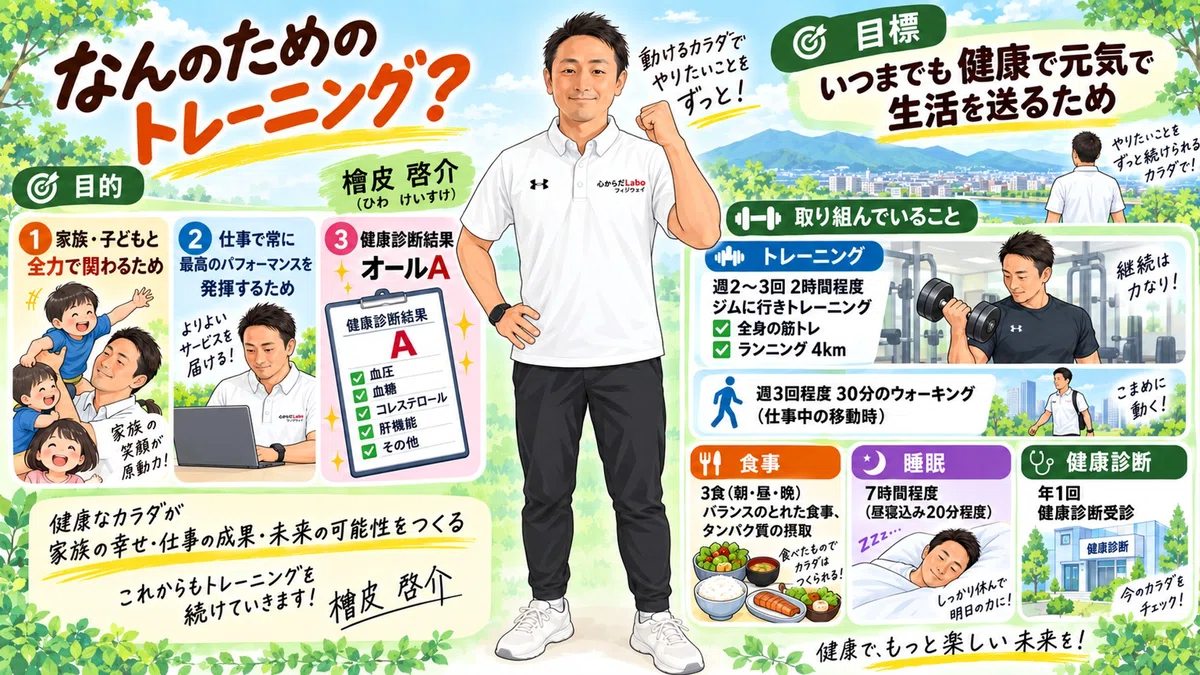
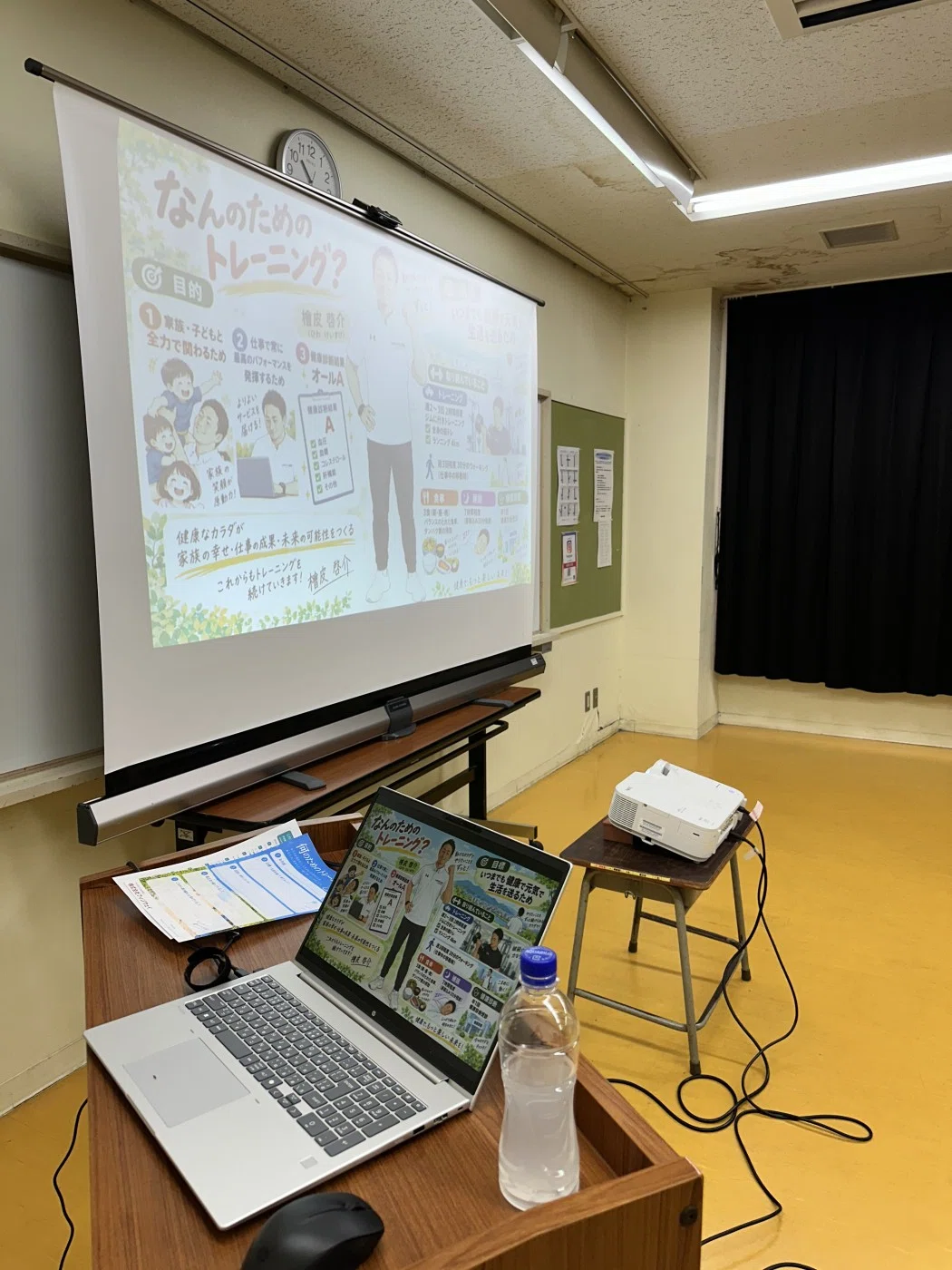
On the day, we used the worksheet ‘What is the training for?’, and
-
Goals (thinking throughout your life)
-
Purpose (what you want to do)
-
What you are currently working on
-
What you are planning to work on in the future
We had the participants write these down. As a reference for how to write them, I also introduced my own ‘Why do I train?’ on the screen.
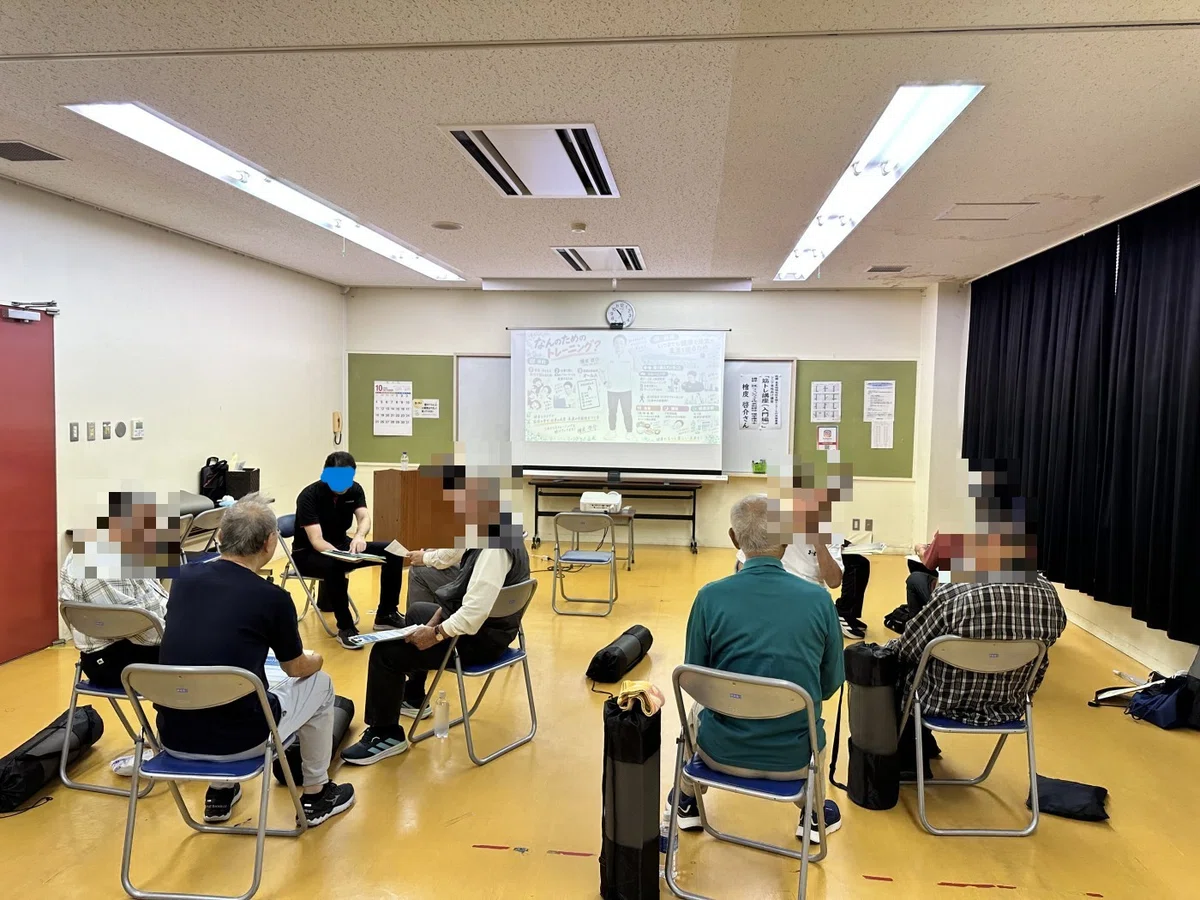
The participants shared what they wrote in small groups and expressed their respective goals to each other.
2. ‘Pain’ is not a given
As you get older, you might feel that ‘it’s inevitable to have back or knee pain.’
However, pain can be related to various factors such as how you use your body, repetition of daily movements, habits, and long periods in the same posture.
Before giving up because of your age, first try reviewing how you use your body. That is the starting point of this course.
*The cause of pain is not necessarily limited to one thing. If symptoms persist, we recommend consulting a medical institution.
3. Knowing your own posture
Next, we looked back at our usual posture.
-
Posture when standing
-
Posture when sitting (chair, sofa, floor, car)
-
Posture when picking up objects
-
How to lean forward
In the course, we introduced 12 patterns of ‘poor posture’ for both standing and sitting. These included slouching, head-forward posture, swayback, leaning to one side, crossing legs, and sitting on the edge of a chair.
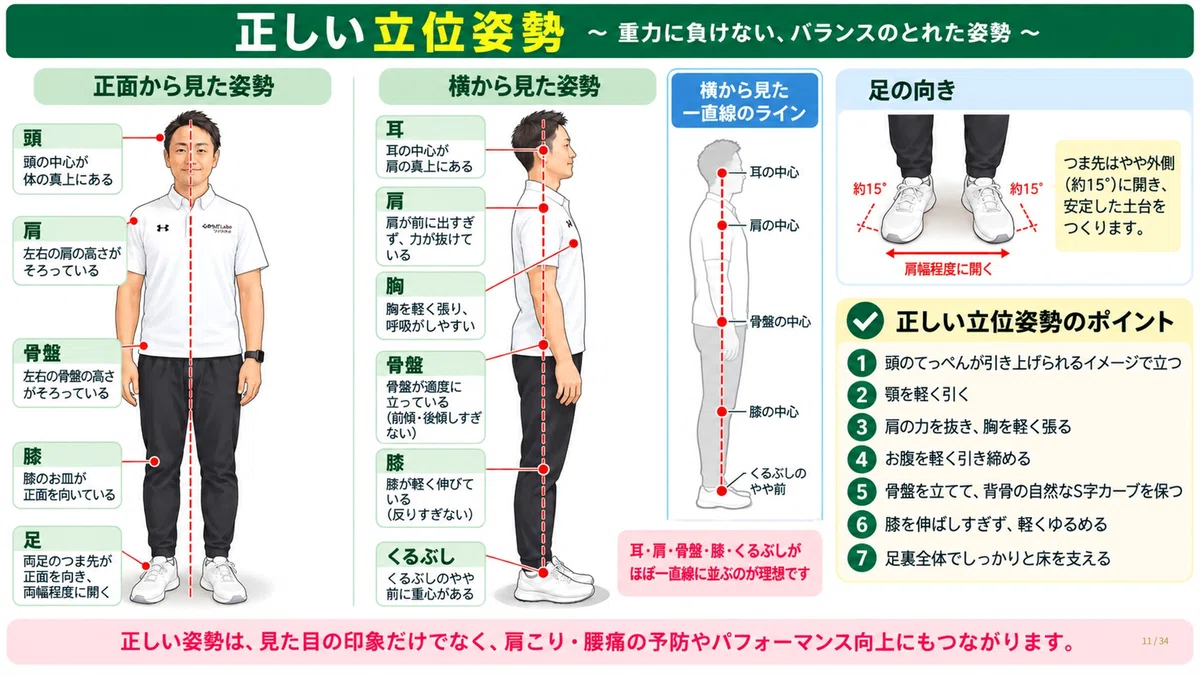
Building on that, I explained the key points of correct standing posture.
-
Stand with the image of the top of your head being pulled upward
-
Tuck your chin in slightly
-
Relax your shoulders and puff out your chest slightly
-
Keep your pelvis upright and maintain the natural S-curve of your spine
-
Do not lock your knees; keep them slightly soft
-
Support yourself firmly with the entire sole of your foot
When viewed from the side, having your ears, shoulders, pelvis, knees, and ankles aligned in a nearly straight line is one benchmark.
4. If you can’t maintain good posture, it’s because you need muscle
“Even if I try to be conscious of good posture, I immediately revert to my old one.”
This is not because your willpower is weak. It is because you need the muscles to support that posture.
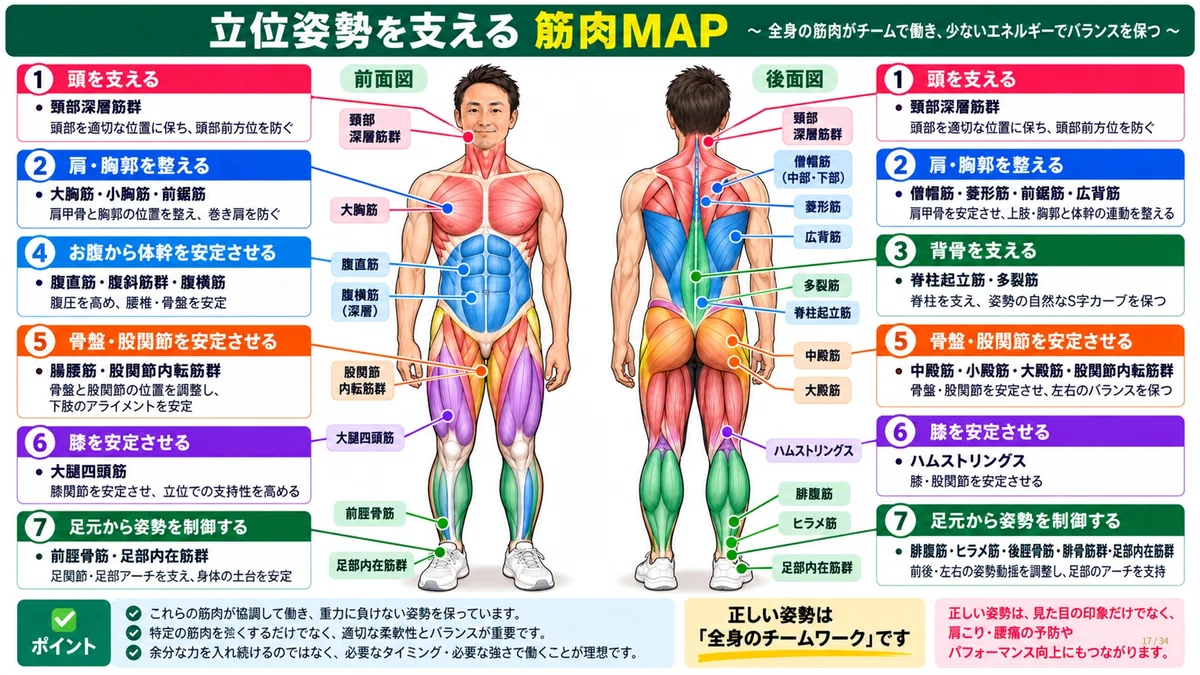
Standing posture is maintained by the muscles of the entire body working together like a team, including the deep muscles of the neck, the area around the back and shoulder blades, the abdomen, the buttocks, the thighs, and the soles of the feet.
Correct posture is not about tensing one specific area, but rather a state where the necessary parts are working at the necessary time.
5. Strength training to support posture, starting with breathing
In the second half of the course, I introduced training to support posture.
The foundation is ‘abdominal breathing’
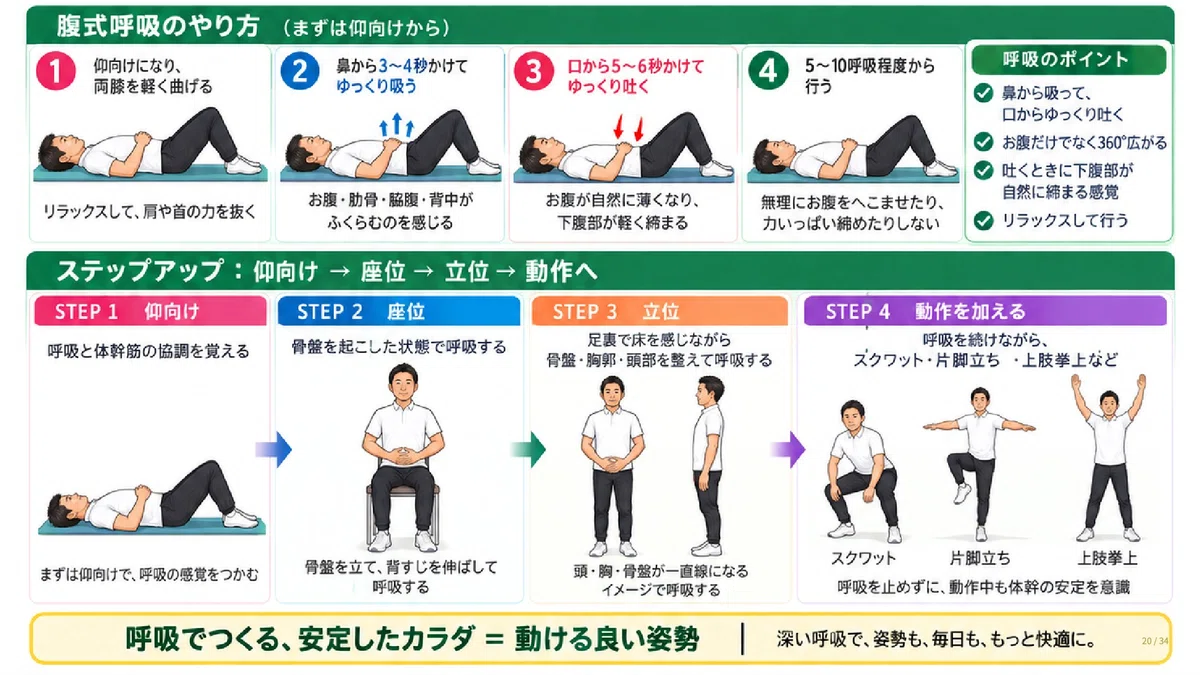
The first thing we worked on was abdominal breathing.
-
Lie on your back and bend both knees slightly
-
Inhale slowly through your nose for 3 to 4 seconds
-
Exhale slowly through your mouth for 5 to 6 seconds
-
Perform 5 to 10 breaths
The key is to inhale with the image of expanding 360° not just into your stomach, but also into your sides and back. Once you get used to it, proceed in stages: lying down → sitting → standing → while performing movements.
Training by body part
Following the breathing exercises, we introduced training that can be done at home without equipment, broken down by body part.
-
Glutes: Bridge, clamshell, squat, single-leg stand
-
Glutes, back, and shoulder blades: Reverse plank
-
Abs: Short crunch, knee-up, cross crunch, side plank
-
Hip joints (iliopsoas): Lying knee-up, seated march, standing knee-up, etc.
-
Chest: Wall push-up, knee push-up, etc.
-
Full-body coordination: Quadruped single-leg extension/single-arm raise, bird-dog
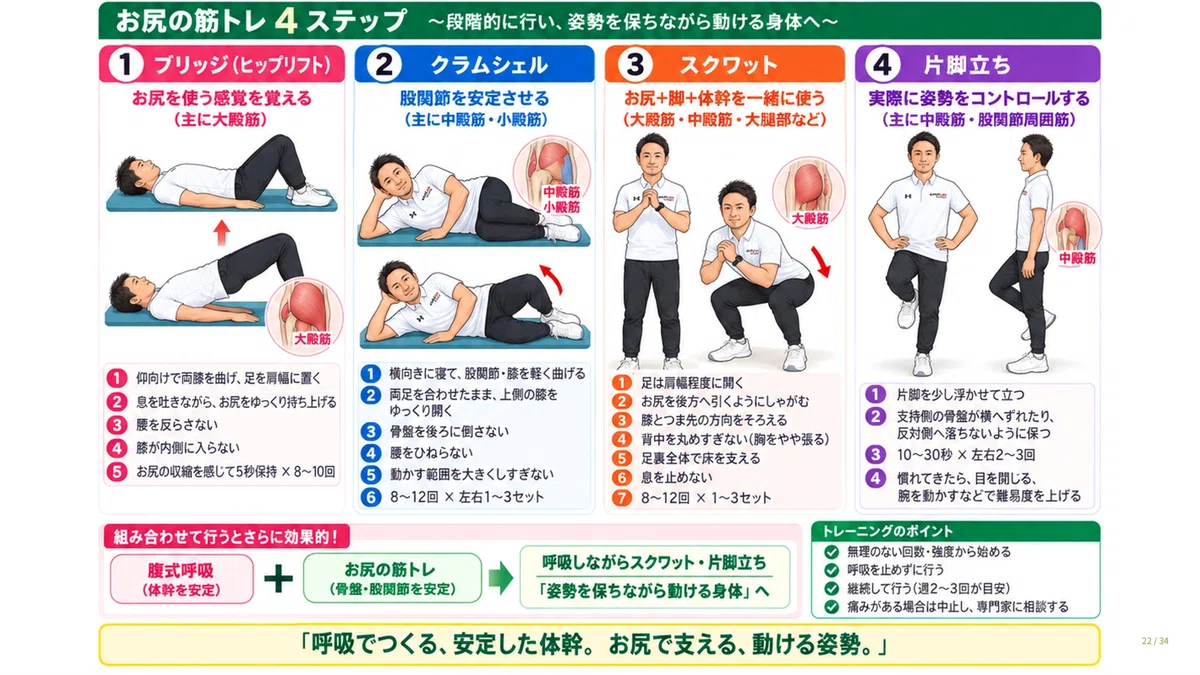
The following four points are common to all training exercises.
-
Do not hold your breath
-
Perform slowly without using momentum
-
Prioritize correct movement over the number of repetitions
-
Do not push yourself if you feel pain
6. The meaning of continuing: ‘For old age? Live for now!’
It is said that physical growth peaks around the age of 20, and from that point on, physical strength and muscle mass will gradually decline if nothing is done.
That is why the concept of healthy life expectancy (the period during which one can live without daily life being restricted by health problems) is so important.
What you do repeatedly now creates your future body.
Not ‘after you get old,’ but little by little starting ‘now.’ In the course, I conveyed this with the phrase ‘Live for now, not just for old age!’
7. Discuss your body with those around you
At the end of the course, I made this request:
Take an interest in your own body, and take an interest in the bodies of others.
I hope that everyone who came here will become healthier and share that with their family, friends, and those close to them. I believe that if the entire community becomes healthier in both mind and body, that would be wonderful.
What I felt as a physical therapist
In this course, before teaching exercise methods, I set aside time for participants to write down ‘what for’ in their own words.
The effects of exercise can only be realized if you continue. And I believe that the strength to continue comes from each person’s specific goals, such as ‘I want to go out with my grandchildren’ or ‘I want to keep walking on my own two feet.’
On the other hand, as an introductory course, there were many exercises introduced, and the time to try each one thoroughly was limited. Next time, I would like to think of a format that is easier to ‘continue,’ such as narrowing down the exercises and increasing the time to check form.
Things you can do starting today
Finally, here are three things you can start doing today based on the course content.
1. Try writing down your ‘what for’ in a single phrase
It can be in everyday language, such as ‘I want to go on a trip with my grandchildren’ or ‘I want to climb stairs easily.’
2. Check your standing posture from the side
Ask a family member or use a mirror to see if your ears, shoulders, pelvis, knees, and ankles are nearly in a straight line.
3. Do 5 breaths of abdominal breathing before going to bed
Inhale through your nose for 3 to 4 seconds, and exhale through your mouth for 5 to 6 seconds. Just starting with this is the first step toward building your body.
Summary
-
Strength training is for building a body that allows you to continue moving like yourself
-
First, think about ‘what it is for’
-
Do not give up and accept pain as ‘normal’; instead, review how you use your body
-
To maintain good posture, you need supporting muscles
-
Build on a foundation of breathing, and proceed little by little within a reasonable range
-
What you repeat today builds your body of the future
We would like to express our sincere gratitude to everyone who worked hard to make this event possible, and to everyone who participated.
At Physiway, physical therapists visit local communities and companies to conduct courses and training sessions that teach the mechanisms and usage of the body.
If you have any inquiries such as ‘I want to hold a health promotion course in my community’ or ‘I want to create an opportunity for employees to learn how to use their bodies,’ please feel free to consult us about physical health.
*This article provides general health information and is not intended for diagnosis or treatment. If you have an underlying medical condition, experience strong pain or numbness during exercise, or have symptoms that persist for a long time, please consult a medical institution before starting exercise.