“Feeling a bit down lately…” The answer might be in the barbell? The fact that “strength training lightens the heart” as shown by 33 RCTs

💡 Introduction
“I’m swamped with work and feeling a bit down…”
“I don’t have confidence in myself, and I find it troublesome to meet people.”
These kinds of worries are things that men often find difficult to confide in others about.
Actually, strength training is effective not only for the body but also for the “mind” as revealed by high-quality research.
And a positive, confident expression alone significantly boosts a man’s “charm” in the eyes of others.
【Conclusion of this article】
-
Strength training has the effect of lightening feelings of depression (depressive symptoms) as shown by a meta-analysis summarizing 33 randomized controlled trials (RCTs).
-
That effect was seen regardless of the amount of training or whether muscle strength increased.
-
First, starting and continuing a reasonable strength training routine 2-3 times a week is the first step to lightening your heart.
🔬 Scientific Evidence: What we learn from the papers
What we are introducing this time is a meta-analysis collecting only randomized controlled trials (RCTs) published in the top psychiatry journal, “JAMA Psychiatry”.
💡 What are RCTs and meta-analyses?
RCTs (Randomized Controlled Trials) are experiments where participants are randomly divided like a lottery into a “strength training group” and a “non-training group” to compare them.
It is a method where bias is less likely to enter, making it easy to verify if it is “truly thanks to strength training.”
Meta-analysis is a technique that collects such RCTs from around the world and re-summarizes them statistically.
It is positioned in the highest class among evidence (scientific grounds).
📋 Study Details
-
Scale: 33 RCTs, total of 1,877 people data
-
Comparison: “Group that did strength training” and “Group that did not exercise”
-
Measurement: Evaluated depressive symptoms (feelings of depression, decreased motivation, etc.) using a questionnaire with confirmed reliability
-
Subjects: Includes a wide range from healthy people to those with some kind of illness
📊 Results
-
In the group that performed strength training, depressive symptoms were significantly reduced.
-
The magnitude of the effect was moderate (effect size 0.66).
-
NNT (Number Needed to Treat) = 4, which means the calculation is “if 4 people do strength training, 1 of them will clearly see an improvement in mood.”
Furthermore, here are three points to pay attention to.
-
Effective for both healthy people and those with illnesses → This is a topic that also relates to “ordinary men who have not been diagnosed with depression.”
-
The effect did not change based on differences in training volume (frequency, repetitions, duration) → You don’t have to be a “hardcore enthusiast.”
-
Effects were seen even when muscle strength did not increase significantly → There is no need to feel down about “not being able to increase the weight.” It is thought that the act of moving your body itself has a positive effect on your mind.
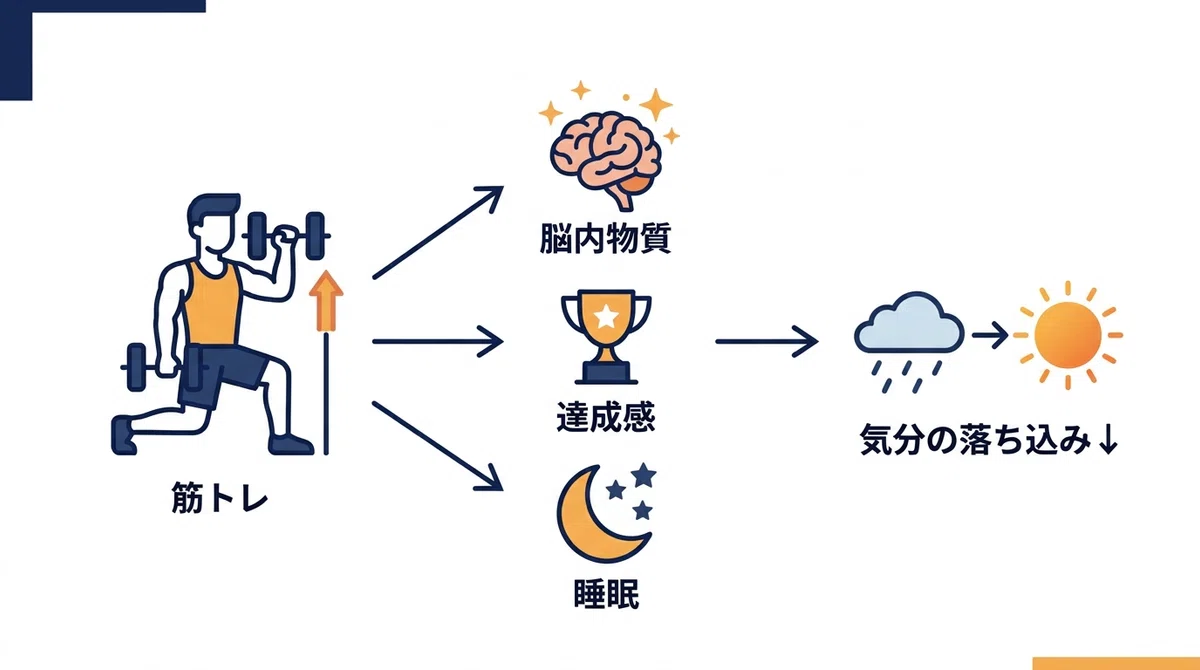
🤔 Why does strength training make you feel better?
While the mechanism has not been fully elucidated, the following processes are considered.
-
Changes in brain chemicals It is thought that exercise increases neurotransmitters (things like “messengers” that transmit information in the brain) that stabilize mood, as well as substances that revitalize brain nerves (such as BDNF).
-
A sense of accomplishment (self-efficacy) from “I did it!” Lifting one more rep than last week, being able to hold a slightly heavier dumbbell—these
accumulated small successes help build the confidence that “I can do it.” -
Improvement in sleep quality A moderate sense of fatigue leads to sleeping soundly. When sleep is regulated, mood also becomes easier to stabilize.
⚠️ Limitations you should know
To be honest, there are a few points to note regarding this research.
-
There was significant variation in results between studies, and in trials conducted with more rigorous methods (such as blinding participants and evaluators), the effect was somewhat smaller (though there was still an effect).
-
This is not a study targeting only men, but data including both men and women.
-
Although this is a slightly older study published in 2018, a large-scale analysis published in the BMJ in 2024 also confirmed that strength training is one of the effective exercises for depression.
⚠️ An important request
If you feel down for more than two weeks, can’t sleep, or find no joy in anything—in such cases, don’t try to handle it with strength training alone; please consult a doctor or professional.
Strength training is a “reliable ally,” not a “substitute” for treatment.
🏋️♂️ Practical advice from the field (How to)
From the research, we can gather that “doing it and keeping it up is more important than the volume or the details of the menu.”
Here is a plan that is easy to follow even on days when you don’t feel like it.
🗓 When and how much?
-
Frequency:
2-3 times a week (with 1-2 days of rest in between) -
Time:
20-45 minutes per session is fine. “Going even for a short time” is the right approach. -
Timing:
We recommend the morning or after work.
Morning strength training in particular helps you start your day with a positive mood (avoid intense training right before bed, as it may interfere with sleep). -
Duration:
Aim for 8-12 weeks to start.
✅ Tips to make it work for your mind too
-
Leave enough energy to do “2-3 more reps”:
You don’t need to push yourself to the limit every time. -
Keep a training log:
Note down the weight and reps to see your “progress” in a visible way.
A sense of accomplishment leads to confidence. -
The “just one exercise” rule for days you don’t feel like it:
Just do one set of squats for now.
Once you start, you’ll find it’s surprisingly easy to keep going. -
Rate your mood out of 10 after you finish:
Noticing the change in your mood before and after training will motivate you to continue.
💪 Summary
-
A meta-analysis of 33 RCTs showed that strength training alleviates depressive symptoms.
-
The effect is seen regardless of training volume or the magnitude of strength gains, and applies to healthy individuals as well.
-
Even if it is just for a short time, 2-3 times a week, “keeping it up” is the shortcut to a positive mind and a confident expression.
Strength training does more than just change the body you see in the mirror.
Every time you grip a barbell, your mind also becomes a little stronger and lighter.
Nice fight today as well.
Let’s do our best together!🔥
[References]
-
Gordon BR, McDowell CP, Hallgren M, Meyer JD, Lyons M, Herring MP. Association of Efficacy of Resistance Exercise Training With Depressive Symptoms: Meta-analysis and Meta-regression Analysis of Randomized Clinical Trials. JAMA Psychiatry. 2018;75(6):566–576. https://doi.org/10.1001/jamapsychiatry.2018.0572