Will strength training make my legs look bulky?
I don’t want to gain too much muscle and end up with a masculine physique.
I want to lose weight, so should I do cardio instead of strength training?
When coaching female clients, I often receive these types of questions.
A particularly common concern is the fear that muscles in the lower body, such as the front of the thighs, will become too large.
They want a toned body, but worry that strength training might actually make them look bigger instead.
Some people may be avoiding strength training because of this concern.
As a personal trainer, I have coached over 300 people during the past 10 years.
From that experience, I want to tell you that muscle development through strength training and the body appearing bulky overall are not necessarily the same thing.
In this article, I will explain the differences between muscle and body fat, the characteristics of muscle hypertrophy in women, and training methods for building a well-defined body.
Conclusion | Women can build muscle, too. However, it does not grow rapidly.
To start with the conclusion, women can also increase muscle mass through strength training.
However, just because you start strength training does not mean your muscles will suddenly grow large in a short period of time.
Muscle growth is influenced by various factors, including training load, frequency, nutrition, recovery, and the duration of the program.
Also, women generally tend to have lower blood testosterone levels than men.
Testosterone is one of the hormones related to muscle growth, but this does not mean that women’s muscles cannot grow.
In fact, women can also increase their strength and muscle mass through appropriate strength training.
What is important is not to fear gaining muscle itself, but to think about what kind of body you are aiming for and which parts you want to develop and to what extent.
1. Reasons why people feel that strength training makes their legs bulky
The most common concern I hear from female clients is about the front of their thighs.
“Squats make my front thighs bulge.”
“I want to slim down my legs, but I’m worried that building muscle will make them thicker.”
There are several factors to consider for these concerns.
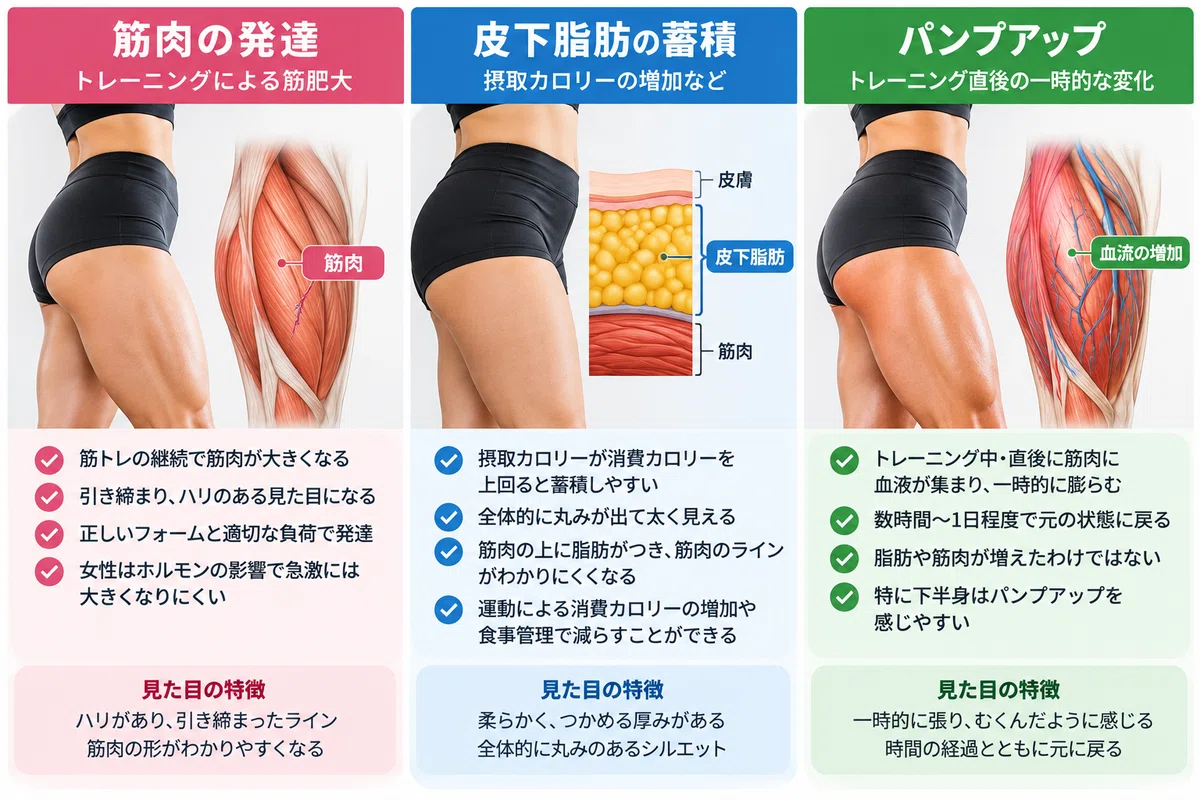
First, if muscles develop through strength training, the size of that area can indeed increase.
This is a natural adaptation to strength training.
On the other hand, if you feel like your legs are bulging immediately after training, it could be due to a temporary increase in blood flow, known as a pump.
Also, the appearance of the thighs is greatly influenced not only by muscle but also by subcutaneous fat.
Even if muscles are developed, if a lot of subcutaneous fat remains on top of them, the entire leg may look thick.
However, you cannot determine whether the cause of thick-looking legs is muscle or fat based on appearance alone.
Since factors like swelling and physical condition are also involved, I comprehensively check weight, body composition, circumference, posture, and training content.
There is no need to think that “thick legs = too much muscle.”
First, it is important to organize what is affecting your appearance.
② When building a toned body, check your daily movements as well
What I emphasize in women’s body makeup is not simply making muscles larger.
I train the necessary areas while checking how you use your body in daily life and your movements during training.
For example, some people seem to concentrate the burden on the front of their thighs during movements like walking or squatting.
However, you cannot judge that a specific muscle is not being used based solely on stride or foot width.
In reality, I check hip joint movement, posture, muscle strength, and movement habits.
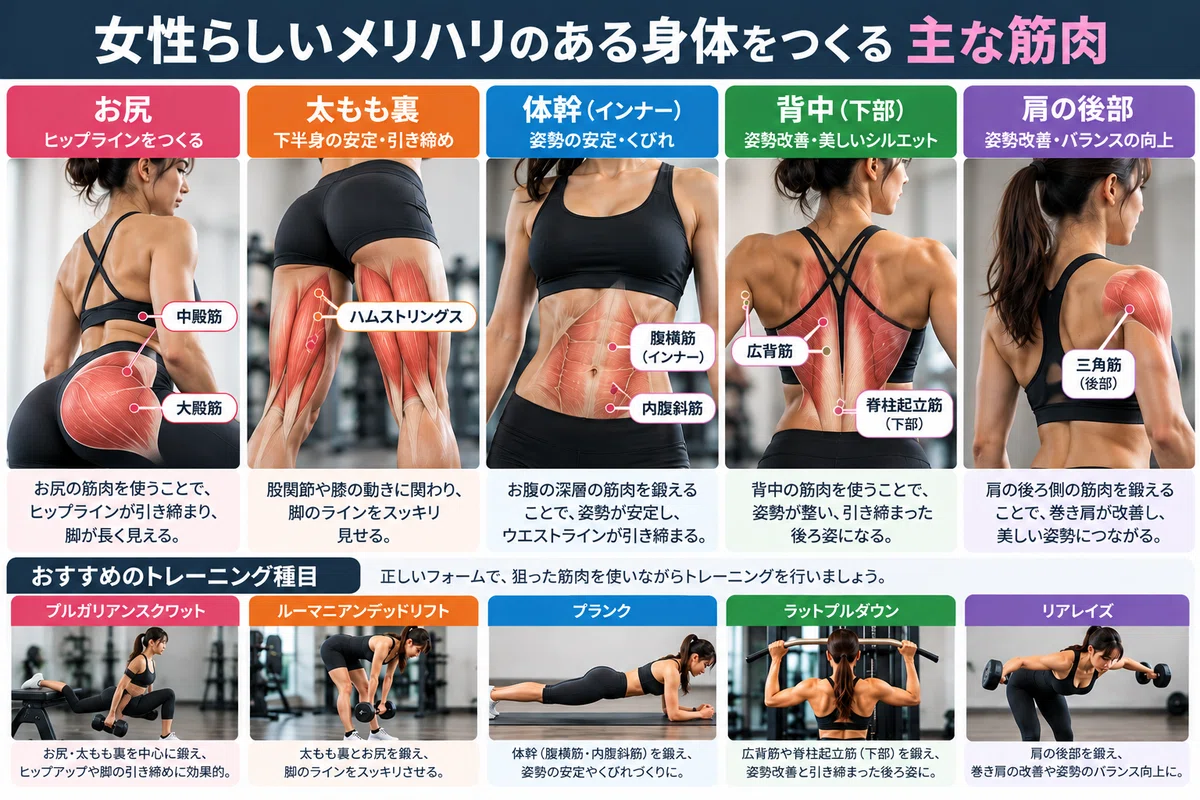
Based on that, I focus training on the following muscles as needed.
-
Back of the thighs (hamstrings): Involved in the movement of the hip and knee joints
-
Glutes (gluteus maximus, gluteus medius, etc.): Involved in hip extension and pelvic stability
-
Deep abdominal muscles: Involved in core stability
-
Lower back and rear shoulders: Support the movement of the shoulder blades and upper body
Of course, just training these muscles alone will not result in your ideal body.
Also, the muscles on the front of the thighs are important muscles necessary for extending the knees and for daily life.
I do not avoid specific areas, but rather structure my training while considering the balance of the entire body.
Clarify the areas you want to train and refine the silhouette of your entire body.
This is the foundation of body makeup as I see it.
③ Should women’s strength training use lighter weights and higher repetitions?
“Women should not handle heavy weights, but rather do 20-30 repetitions with light weights.”
You may have heard this way of thinking.
However, muscle hypertrophy does not only occur with light weights, nor does it only occur with heavy weights.
Meta-analyses comparing low-load and high-load strength training have shown that when performed with sufficient effort, muscle hypertrophy can be expected across a wide range of load settings. [1]
On the other hand, handling relatively high loads tends to be advantageous for improving maximum strength.
When I instruct female clients, I basically use about 15 reps x 3 sets as a guideline.
However, I do not apply the same number of repetitions to everyone.
I adjust it based on training experience, the exercise, and the goal.
What I emphasize most is form.
If increasing the weight causes the body to arch significantly, momentum to be used, or strain to be concentrated on areas other than the target, I will review the load.
First, I have them master the correct movement, and then gradually increase the weight or repetitions.
Just because you are a woman does not mean you should only handle light weights.
It is important to grow by using a load that suits your body while maintaining proper form.
④ Even if your weight does not change, you can change your body lines
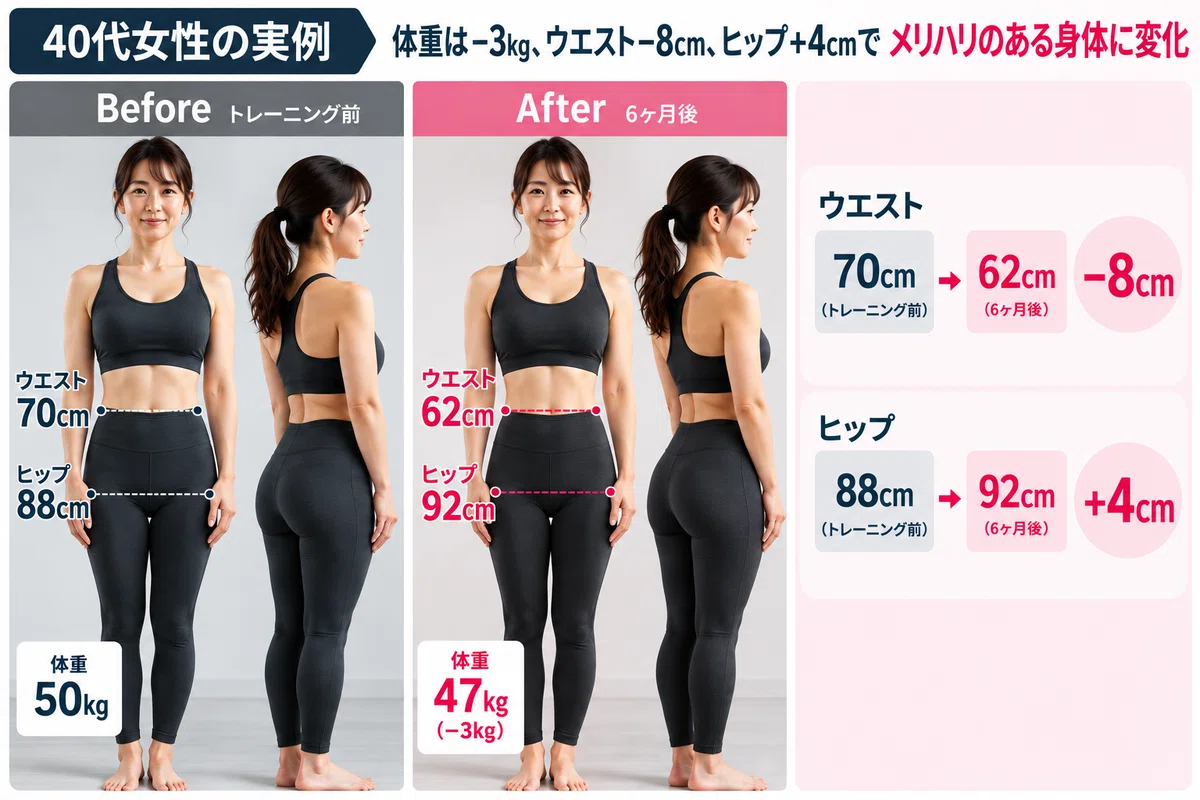
Here, I would like to introduce a case study of a female client in her 40s whom I actually coached.
She continued her training for six months.
As a result, the following changes were seen in her body measurements.
Waist: -8cm
Hips: +4cm
In other words, the difference in circumference between her waist and hips increased by 12cm from the start.
By tightening the waist and adding roundness to the hips, she achieved a more defined body line than before.
She also worked on daily stretching, and improvements were seen in her posture, which had previously looked like rounded shoulders.
However, you cannot determine how many kilograms of muscle were gained just by the increase in hip size.
Also, regarding the change in posture, it cannot be concluded that stretching was the only cause.
Nevertheless, this case was impressive to me.
This is because it made me realize once again that losing weight is not the only achievement in body makeup.
Various changes, such as the balance between the waist and hips, how you use your body, and your posture, all contribute to your visual impression.
It is important to evaluate the body lines themselves, not just the numbers on the scale.
⑤ Changes in muscle and body fat differ depending on calorie intake
Diet is also important for building muscle.
What I tell my female clients is to understand the relationship between calorie intake and calorie expenditure.
When calorie intake exceeds calorie expenditure, it becomes easier to secure the energy necessary for muscle growth.
However, if the calorie surplus is too large, body fat is also more likely to increase.
On the other hand, even if calorie intake is about the same as or slightly lower than calorie expenditure, it does not mean that muscle hypertrophy will not occur at all.
Especially for strength training beginners or those with relatively high body fat, it is possible to increase muscle mass while reducing body fat through appropriate strength training and nutritional management.
In fact, there are studies confirming that even under energy restriction, combining a high-protein diet with exercise can lead to an increase in lean body mass and a decrease in body fat mass. [2]
However, this study targeted young men, and the same results do not necessarily apply to all women.
Also, an increase in lean body mass does not necessarily mean an increase in muscle alone.
I believe that for women’s body makeup, it is important to adjust calorie intake and nutritional balance according to goals, rather than simply reducing food intake.
6. Pay attention to the menstrual cycle and energy deficiency in women’s dietary management
What I want to be especially careful about in women’s body makeup is excessive dietary restriction.
I do not recommend drastically reducing calorie intake or restricting fat more than necessary just because you want to lose weight quickly.
If energy deficiency continues for a long period, it may have adverse effects on menstrual function and bone health. [3]
Also, some people feel changes in their weight and physical condition due to hormonal fluctuations associated with the menstrual cycle.
Even if your weight increases before menstruation, it does not necessarily mean that your body fat has increased.
Changes in water retention and gastrointestinal contents are also possible factors.
Therefore, I avoid giving guidance that immediately reduces food intake just because weight has temporarily increased.
I make judgments while checking weight trends over several weeks, physical condition, and menstrual status.
Also, sufficient protein is important for the maintenance and growth of muscle.
For those who exercise, approximately 1.4 to 2.0g of protein per 1kg of body weight per day is suggested as a guideline. [4]
However, the required amount varies depending on the amount of exercise and health condition.
It would be counterproductive to work hard at strength training while lacking the nutrients your body needs.
To tone your body, a diet that maintains your health is the foundation.
7. Gaining muscle does not just mean making your body bulky
There is something I really want women who avoid strength training for fear of gaining too much muscle to know.
That is, the purpose of building muscle is not simply to make the body larger.
By training specific areas according to your goals, such as the glutes or back, you can change your body lines.
Also, if your muscle strength improves, daily movements may become easier.
Furthermore, strength training is important for maintaining health.
Maintaining muscle strength as you age is also related to your future quality of life.
Of course, the ideal body varies from person to person.
Some people want to build larger muscles, while others want to maintain as slim a line as possible.
Neither is more correct than the other.
I value respecting the body that the client themselves aims for and building a training program tailored to that goal.
What I would do | 4 steps to aim for a toned body
For women who are about to start strength training, I recommend the following four steps.
STEP 1 | Check your body lines, not just your weight
Record your waist and hip measurements, photos, and posture.
STEP 2 | Check your daily movements and muscle strength
Check your squats and hip joint movements, and incorporate conditioning as needed.
STEP 3 | Start strength training with 15 reps x 3 sets as a guideline
Prioritize form, and once your movements become stable, gradually increase the load.
STEP 4 | Continuously monitor your diet and physical changes
While adjusting your caloric intake and protein levels, monitor not just your weight, but also your measurements and changes in appearance.
What is important is not to expect major changes in a short period of time.
There are individual differences in how the body changes.
I recommend taking your time and working on it over the course of several months.
Summary | Strength training is a means to build your ideal body
Strength training does not necessarily make a woman’s body bulky.
While muscles grow through appropriate stimulation, changes in appearance are related to various factors, including body fat, muscle development, and posture.
Furthermore, body transformation is not just about losing weight.
By building muscle in the necessary areas and balancing your entire physique, you can aim for a toned and well-defined body.
What I value is not simply becoming thin, but helping each person build their ideal body in a healthy way.
Do not be overly afraid of gaining muscle, and try starting with a strength training routine that suits you.
References
[1] Schoenfeld BJ, et al. Strength and Hypertrophy Adaptations Between Low- vs. High-Load Resistance Training: A Systematic Review and Meta-analysis. Journal of Strength and Conditioning Research. 2017;31(12):3508–3523. https://doi.org/10.1519/JSC.0000000000002200
[2] Longland TM, et al. Higher compared with lower dietary protein during an energy deficit combined with intense exercise promotes greater lean mass gain and fat mass loss: a randomized trial. American Journal of Clinical Nutrition. 2016;103(3):738–746. https://doi.org/10.3945/ajcn.115.119339
[3] Mountjoy M, et al. 2023 International Olympic Committee’s (IOC) consensus statement on Relative Energy Deficiency in Sport (REDs). British Journal of Sports Medicine. 2023;57:1073–1097. https://doi.org/10.1136/bjsports-2023-106994
[4] Jäger R, et al. International Society of Sports Nutrition Position Stand: protein and exercise. Journal of the International Society of Sports Nutrition. 2017;14:20. https://doi.org/10.1186/s12970-017-0177-8