MENTAL health has emerged as a leading concern for Gen Z workers as economic pressures continue to weigh on job markets worldwide.
These Zoomers are not only seeking more open conversations around psychological well-being, but also greater institutional support from employers.
According to a 2024 “State of the Graduate” report by job search platform Monster, the issue was influencing companies’ ability to retain talents.
“Up to 92% of Gen Z want to be able to discuss mental health as the focus on work-life balance gains momentum,” it said.
“This is having an effect on their willingness to stay at their place of employment.”
However, expectations are not always matched by workplace realities.
A 2025 study titled “The Gen Z Effect and the Workforce Evolution” by Taiwan-based talent agency Cake found that many young workers remained hesitant to raise mental health concerns with their superiors.
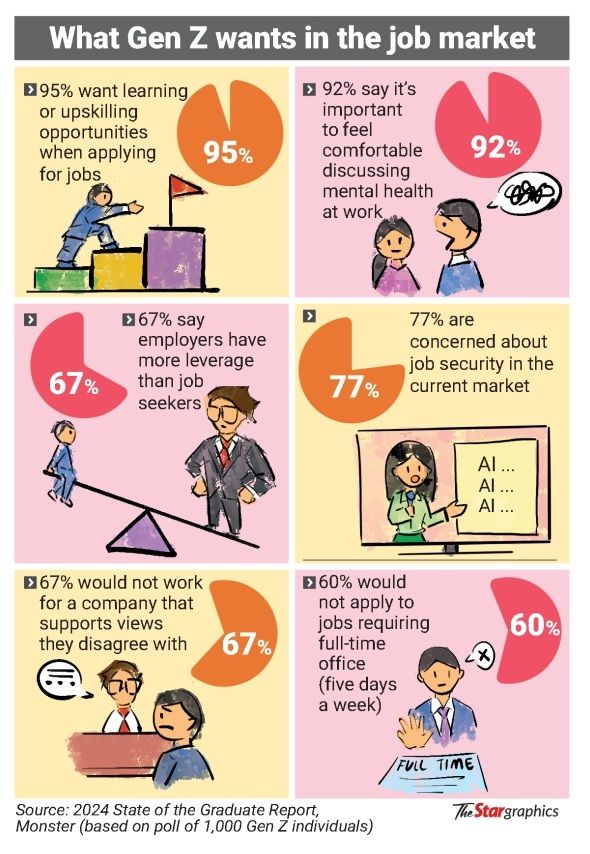
“Only 52% believed their managers would be able to support them, whereas 26% worried they would be discriminated against if they tried openly discussing these issues,” it said.
Flexible working arrangements are another key priority.
A 2025 study by consulting firm Gallup found that only 20% of Gen Z employees preferred fully remote roles, while two-thirds favoured hybrid arrangements.
The report said many in this cohort entered the workforce during the Covid-19 pandemic, when work-from-home (WFH) practices became widespread.
While WFH has remained attractive, some respondents expressed concerns it could limit opportunities for social interaction, which they viewed as important for long-term career development, it added.
Personal values are also playing an increasing role in employment decisions.
The Cake study found that 44% of respondents felt strongly about issues such as carbon footprint, impact on social inequality and employers’ approaches to work-life balance.
“Gen Z also expect a workplace to have ethical business practices (81%) and a strong commitment to diversity and inclusion (43.1%),” it added.
At the same time, advances in artificial intelligence are reshaping entry-level opportunities as automation increasingly takes over jobs traditionally handled by junior talents.
A study by recruitment agency Randstad “The Gen Z Workplace Blueprint” reported that entry-level job postings had declined by 29% since January 2024.
Despite these challenges, the report said young workers had remained resilient.
“While there have been concerns about long-term career prospects, many young workers are ambitious and focused on meaningful careers,” it said. — By FARID WAHAB