Reviewed by Dietitian Katey Davidson, M.Sc.FN, RD, CPT

Credit: Josh Seong
Key Points
-
Endurance exercise boosts heart health and strength and supports healthy aging.
-
At-home moves like squats, chest presses, carries and brisk walks build stamina.
-
Stay consistent, progress gradually and fuel well for best results.
Staying active is key to healthy aging. Regular physical activity not only lifts your mood and improves sleep, but over time, it can also lower blood pressure and reduce your risk of type 2 diabetes, cardiovascular disease and certain cancers.
While all forms of exercise are important, endurance training should be a priority in your fitness routine. Endurance exercise builds both muscular and cardiorespiratory endurance, helping your muscles, heart and lungs perform better during sustained activity.
“Maintaining physical endurance is a key part of how well we age,” says Roxana Ehsani, M.S., RD, CSSD. “Regular activity helps preserve muscle and bone strength, supports heart health, improves balance and coordination and keeps metabolism strong.”
“Your heart delivers oxygen throughout your body, so keeping it strong is essential. Endurance training also helps prevent chronic disease and enhances overall quality of life,” adds exercise physiologist Christopher Mohr, Ph.D., RD.
The challenge? As life gets busier with age, it’s easy for exercise to take a back seat. When that happens, even simple tasks—like carrying groceries or playing with your kids—can feel exhausting rather than enjoyable.
The good news: You don’t need a gym to stay fit. With just a few simple exercises you can do at home, you can rebuild stamina, support heart health and feel strong and energized every day. Try these four exercises to test your endurance and get moving today.
1. Body-Weight Squat

Credit: Josh Seong
No equipment? No problem. Mohr is a fan of incorporating body-weight exercises into fitness programs because they can be done anywhere: “You can do these at home, in a hotel room or wherever you are.” Full-body movements, like squats and lunges, not only help build lower-body strength but also test endurance. In fact, research shows incorporating “exercise snacks”—short bouts of movement throughout the day—such as body-weight squats, can help muscles use nutrients more effectively to support total-body health.
How to Do It:
-
Start with feet shoulder-width apart, toes slightly turned out.
-
Engage your core, pull your shoulders back and lift your chest. Inhale as you begin to lower.
-
Push your hips back and bend your knees as if sitting in a chair.
-
Lower your body as far as comfortable, aiming for your thighs to be roughly parallel to the floor.
-
Keep your weight in your heels, then push back up and exhale as you return to standing.
-
Repeat 10–15 times for 2–3 sets.
Tip
If you’re struggling to reach a full squat, Mohr suggests lowering only as far as comfortable. As your lower-body strength and stamina improve, you can gradually go deeper.
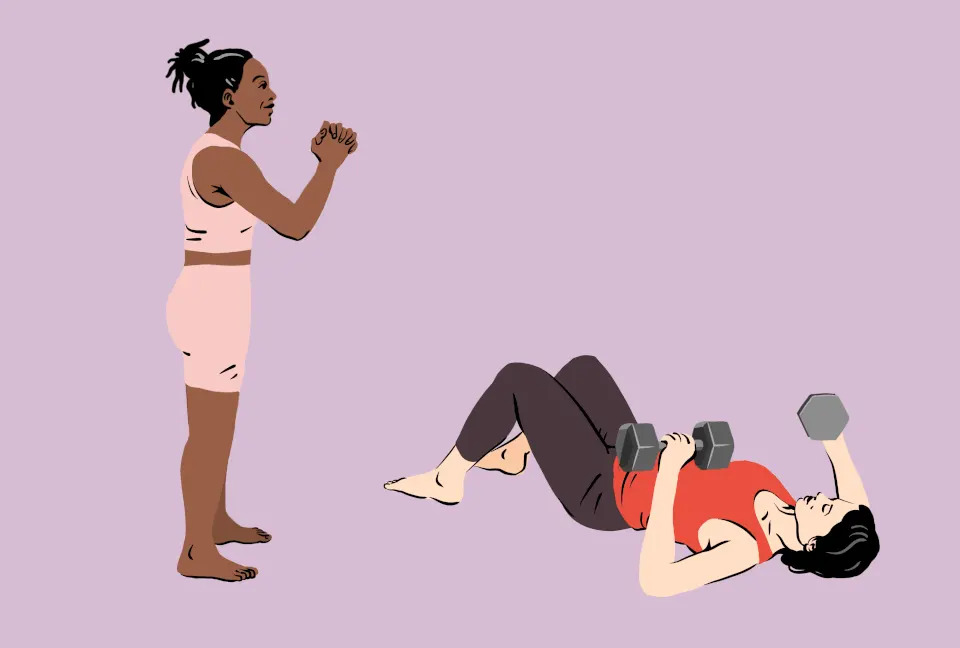
2. Chest Press

Credit: Josh Seong
“Weightlifting is an underrated but highly effective activity to start at any age, including over 45,” says Ehsani. “Lifting weights doesn’t just strengthen your muscles, it also helps improve bone density while supporting posture, coordination and metabolic health.” Simply put, adding resistance training makes everyday tasks—like carrying your suitcase up the stairs—feel easier.
The chest press is a compound movement that activates multiple muscle groups in your upper body, including the biceps, triceps, shoulder and chest muscles. Ehsani encourages clients to start with weights they feel comfortable using, noting, “Even light weights such as 3- to 5-pound weights and doing 2 to 3 sets of 10 to 15 reps will result in benefits.”
How to Do It:
-
Lie on your back on the floor with knees bent and feet flat.
-
Hold a dumbbell in each hand at chest level, elbows bent at about 90 degrees.
-
Keep your core tight and your back gently pressed into the floor.
-
Exhale as you press the weights toward the ceiling. Fully extend your arms, but avoid locking your elbows.
-
Inhale as you slowly lower the weights slowly back to chest level with control.
-
Repeat 10–15 times in 2–3 sets.
Tip
If you have an exercise bench, you can perform this exercise on it to allow for a greater range of motion. Just avoid lowering the weights too far, keep your feet planted on the floor and move with control to protect your shoulders.
3. Farmer’s Carries

Credit: Josh Seong
Also called a weighted carry, Mohr recommends this move to build core, back and total-body strength while also building cardiorespiratory and muscular endurance. “This exercise is as simple as carrying a weight and walking,” he explains. “You can hold it at your side, at your chest, overhead, really any way that works for you, over a short distance.”
Popular in endurance training, farmer’s carries may look intense, but you don’t need to lift heavy to reap the benefits. Start small by carrying a light dumbbell, a backpack or even a bag of canned goods. Really, anything that can be carried will work.
How to Do It:
-
Grab a single dumbbell or a pair of dumbbells (or weighted household items). Start light to assess your strength.
-
Stand with feet shoulder-width apart, core engaged and shoulders back.
-
Hold the weights at your sides (or at one side if using a single weight).
-
Walk forward with controlled steps for a set distance—ideally at least 10–20 feet. If you’re short on space, walk to a point and back to your starting spot.
-
Rest and repeat, putting the weight down between sets. Aim for 2 to 3 rounds.
Tip
Adjust your weight and carrying position based on your comfort level and personal health needs.
A word of caution: Research suggests that weighted carry exercises like farmer’s carries can temporarily increase blood pressure, which may pose a risk for people with certain heart conditions. If you experience dizziness, shortness of breath or a noticeable spike in blood pressure while performing this exercise, stop immediately and check in with your health care provider before continuing.
4. Brisk Walking

Credit: Josh Seong
Mohr and Ehsani both recommend adding a brisk walk to your everyday fitness routine. “Brisk walking is a wonderful way to move your body and build up cardiovascular endurance. It requires no special equipment, just a safe path such as a sidewalk, bike path or even treadmill to get your steps in,” says Ehsani.
Adding short walking bouts is also one of the recommended “exercise snacks” that research suggests may help positively influence how your body uses nutrients to support your total-body health. Recent studies even show a 10-minute walk after eating may support healthy blood sugar levels.
How to Do It:
-
Lace up those shoes and head outside or hop on a walking pad.
-
Walk at a pace that is comfortable but elevates your heart rate. A good test is that you can still talk but it feels slightly challenging.
Tip
“To increase the challenge, find a hill to walk up and down or add some faster intervals in there as well as part of your walk to really get your heart rate pumping,” says Mohr.
Tips for Improving Endurance
These four exercises are a great starting point, but they’re not the only way to enhance your endurance. Mohr and Ehsani also shared these tips to help you make the most of your healthy aging and fitness journey:
-
Prioritize Consistency. Aim for regular movement over occasional intense workouts. It’s better to do a few strategic exercises regularly at home than to hit the gym only a few times a month.
-
Start Slow and Progress Gradually. Small, steady increases add up. Try adding a few minutes or reps, an extra session or slightly more intensity each week to build endurance safely.
-
Include Intervals. Mix moderate-paced activity with short bursts of higher intensity. As your body adapts and grows stronger, intervals can provide a new challenge and boost your endurance gains.
-
Fuel Your Body with Solid Nutrition. Support your workouts with a balanced diet rich in fiber, lean proteins, healthy fats, vitamins and minerals to maintain energy and promote recovery.
Our Expert Take
Staying active is essential for healthy aging, but busy schedules can make it tough to fit in a full workout. That’s where simple, at-home endurance exercises come in. They’re effective, efficient and easy to stick with. Another bonus? They don’t require any expensive equipment, making them accessible and convenient for just about anyone.
It’s time to get your heart pumping and your feet moving. Small, consistent steps today can support your strength, stamina and long-term health for years to come.
Read the original article on EatingWell