Are strength training and jump exercises necessary for long-distance runners? Confirmed by a meta-analysis of 38 studies|走る論文ノート


Introduction
“Should long-distance runners also do sprint-like training?” Many people are curious about whether they should include jumps, short all-out sprints, or strength training in their routines.
In this article, I will introduce a meta-analysis (38 studies) on strength training for middle- and long-distance runners published in Sports Medicine in 2024. To start with, the effect of “short all-out sprints” themselves was not clear in this study. I will honestly summarize what was learned about “strength and jump-based” training.
What this study investigated
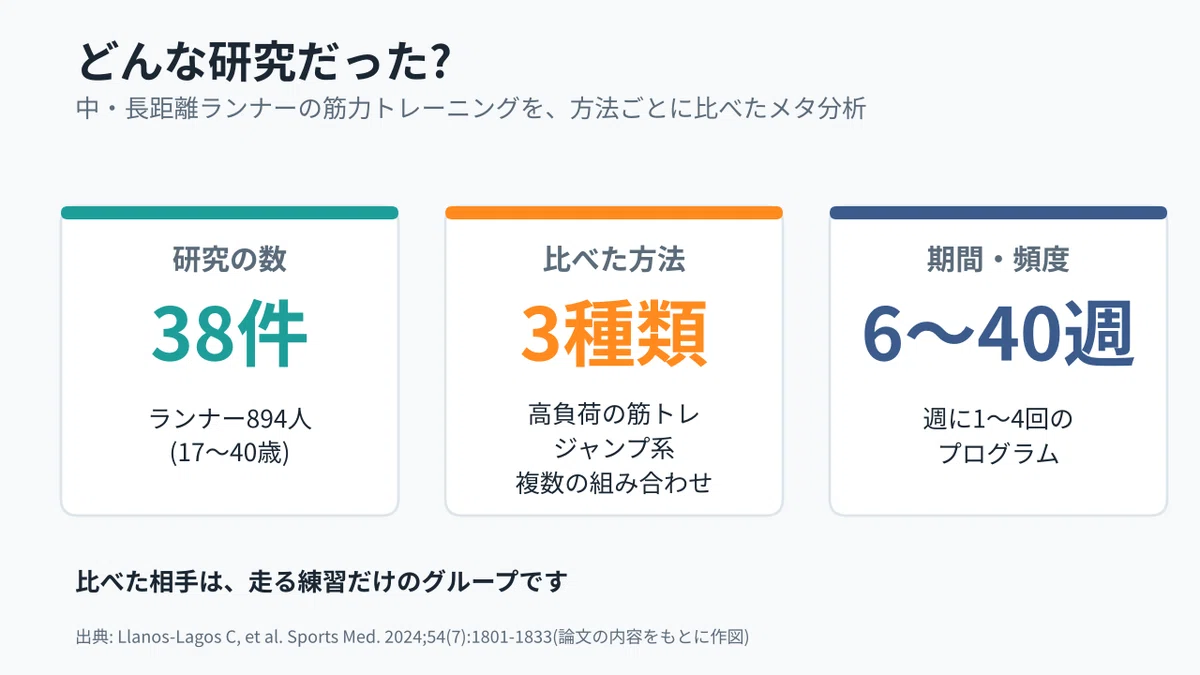
This is a meta-analysis (Llanos-Lagos et al., Sports Med, 2024) that compared how performance and physical fitness indicators change when middle- and long-distance runners perform strength training in addition to their running practice, categorized by method.
-
Subjects: 38 studies, 894 people (65 men, 243 women, ages 17–40). The level was runners trained from moderate to high levels
-
Methods compared: High-load (80% or more of maximum), plyometrics (jump-based), and combinations of multiple methods
-
Comparison group: Groups doing only running practice (or groups doing only very light-load strength training)
-
Duration and frequency: Programs were 6–40 weeks, 1–4 times per week
-
Indicators observed: Performance such as time trials or time to exhaustion, maximal oxygen uptake, sprint ability, etc.
What was found
The numbers are the “magnitude of difference (Hedges’ g).” In the paper’s figures, a negative value for time-based indicators indicates that “the strength training side is better.” Viewing 0.2, 0.5, and 0.8 as “small, medium, and large” is a general guideline (not the paper’s criteria).
Performance (time trials, time to exhaustion)
-
High-load strength training: g = -0.469 (95% confidence interval -0.872 to -0.066). This was a moderate improvement and was statistically significant. The certainty of evidence is “moderate.”
-
Plyometrics (jump-based): g = -0.210 (-0.433 to 0.014). In this study, it could not be said to be statistically significant.
-
Combination of multiple methods: g = -1.035 (-1.967 to -0.103). It was significant with a large improvement, but the variation between studies was large (I²=67.5%), and the certainty of evidence is evaluated as “very low.”
Physical fitness indicators and sprint ability
-
Maximal oxygen uptake, velocity at maximal oxygen uptake (vVO2max), and maximal lactate steady state (MLSS) showed no significant changes with any method.
-
Sprint ability: g = -0.493 (-1.057 to 0.070) for the combination method. It could not be said to be significant. Only the combination method could be analyzed for this indicator.
Differences in conditions that divided the studies
-
There were no significant differences in results based on gender, age, level, strength training experience, duration, or frequency. It cannot be said that there is an ‘optimal number of times per week.’

Effects on running economy
Another meta-analysis by the same team (Llanos-Lagos et al., Sports Med, 2024) examined ‘energy efficiency when running at the same pace.’ The conclusion is that high-load strength training, plyometrics, and a combination of multiple methods may improve running economy (according to the abstract’s conclusion).
Additionally, a 2016 meta-analysis (Balsalobre-Fernández et al.) targeting well-trained runners also reported significant improvements in running economy with strength training and jump-based programs. The programs involved 2–3 sessions per week for 8–12 weeks, consisting of up to 100 jumps or 5–10 short sprints (original text verification required).
How to apply this to training
What can be said from the papers is only a guideline. Based on these results, I do not recommend forcibly increasing the volume.
For recreational runners
-
Adding strength training or jumps rather than ‘just running’ may lead to better performance (especially high-load strength training, where the certainty of evidence is ‘moderate’).
-
The subjects of this study are 17–40 years old. Whether the same applies to those over 40 cannot be determined from this data.
-
High-load strength training and jumps can cause injury if form or weight is incorrect. If you are a beginner, please consult a professional such as a trainer or physical therapist.
Regarding ‘short all-out sprints’
-
In this meta-analysis, the improvement in sprint ability could not be called significant. Sprint ability could only be analyzed in studies that combined multiple methods.
-
It cannot be said from the results of this study that ‘doing short all-out sprints will make you faster at long distances.’ This is a topic for future research.
For middle and long-distance (800–5000m) athletes
Limitations and points of caution for this study
-
The results for ‘combinations of multiple methods’ have large variations between studies, and the certainty is ‘very low.’ Do not rely solely on the large numbers.
-
‘Light-load (40–79%)’ strength training has few studies and has not been analyzed.
-
Many studies on sprint ability combine strength training and sprint practice. It is impossible to separate whether the effect is from the strength training or the sprint practice (the authors also state this).
-
The authors also note that the results for plyometrics differ from previous meta-analyses.
-
Some of the data were read from the figures.
-
The subjects were 17 to 40 years old. It is unclear if this applies to older individuals.
-
This article is an introduction for the general public. It is not training guidance. If you have injuries or underlying health conditions, please consult a professional.
Summary
-
In a meta-analysis of 38 studies and 894 people, high-load strength training had the potential to improve the performance of middle- and long-distance runners (moderate certainty of evidence).
-
Combining multiple methods leads to greater improvements, but the certainty is very low.
-
There were no significant changes in physical fitness indicators such as maximal oxygen uptake.
-
The effect of “short all-out sprints themselves” is unclear in this study.
What is your training like? Please let me know
I would appreciate it if you could leave a comment or a like, as it will help me write the next article. You can answer the questions below or write freely in the comments.
-
Besides running practice, do you do strength training or jump-based exercises? How many times a week?
-
Do you include short all-out sprints (strides or sprints) in your long-distance training?
-
Which would you like to read about next: “ground contact time” or “late-race deceleration”?
Other than this, if you have any concerns about training or research papers, things you have tried, or questions that have popped into your mind, please let me know in the comments, no matter what it is. Based on what you provide, I will look for research papers for the next article and introduce them. I look forward to hearing from you.
Source
Llanos-Lagos C, Ramirez-Campillo R, Moran J, Sáez de Villarreal E. The effect of strength training methods on middle-distance and long-distance runners’ athletic performance: a systematic review with meta-analysis. Sports Medicine. 2024;54(7):1801-1833.
DOI: 10.1007/s40279-024-02018-z(PMID: 38627351)
Related research introduced:
Llanos-Lagos C, Ramirez-Campillo R, Moran J, Sáez de Villarreal E. Effect of strength training programs in middle- and long-distance runners’ economy at different running speeds: a systematic review with meta-analysis. Sports Medicine. 2024.
DOI: 10.1007/s40279-023-01978-y
Balsalobre-Fernández C, Santos-Concejero J, Grivas GV. Effects of strength training on running economy in highly trained runners: a systematic review with meta-analysis of controlled trials. J Strength Cond Res. 2016;30(8):2361-2368.
DOI: 10.1519/JSC.0000000000001316 (PMID: 26694507)