Now that I have been doing strength training for four years, I feel various changes
beyond just muscle size and the weight I can handle.
My body feels lighter than before. My mood has become more stable.
My skin condition has also improved.
Of course, it is not certain that all of these are due to strength training.
Even so, when I looked into the relationship between strength training and health, I found that
it has various functions beyond just muscle size.
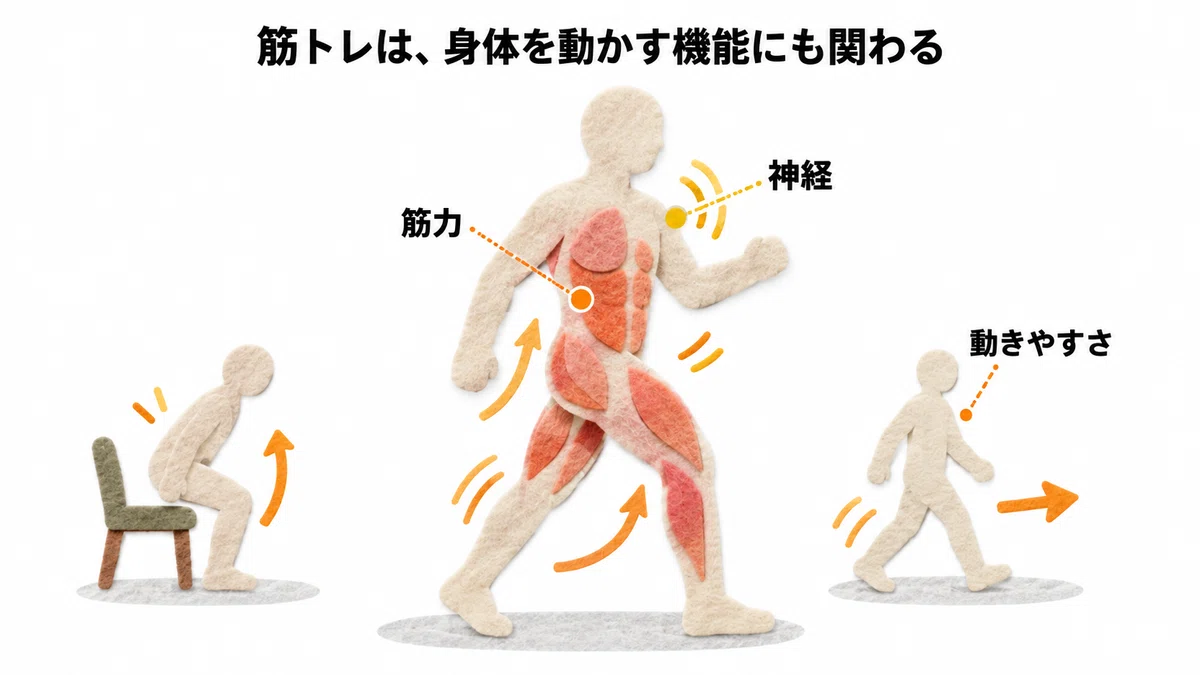
Strength training is also involved in the function of moving the body
Muscular strength is not determined solely by muscle size.
Another factor involved is the function of the nerves that move the muscles.
When you repeat strength training, adaptations also occur in the nervous system,
improving your ability to exert force.
When you first start, your strength may increase even before your muscles get bigger.
Also, a 2025 study summarizing 151 trials showed that
in adults aged 60 and over, even with relatively low training volumes, physical functions such as standing up and walking improved
.
However, it is considered advantageous to increase training volume for greater strength gains.
Although the subjects were mainly healthy elderly people, strength training not only builds muscle,
but also plays a role in supporting the functions that move the body.
Strength training is also related to mental health
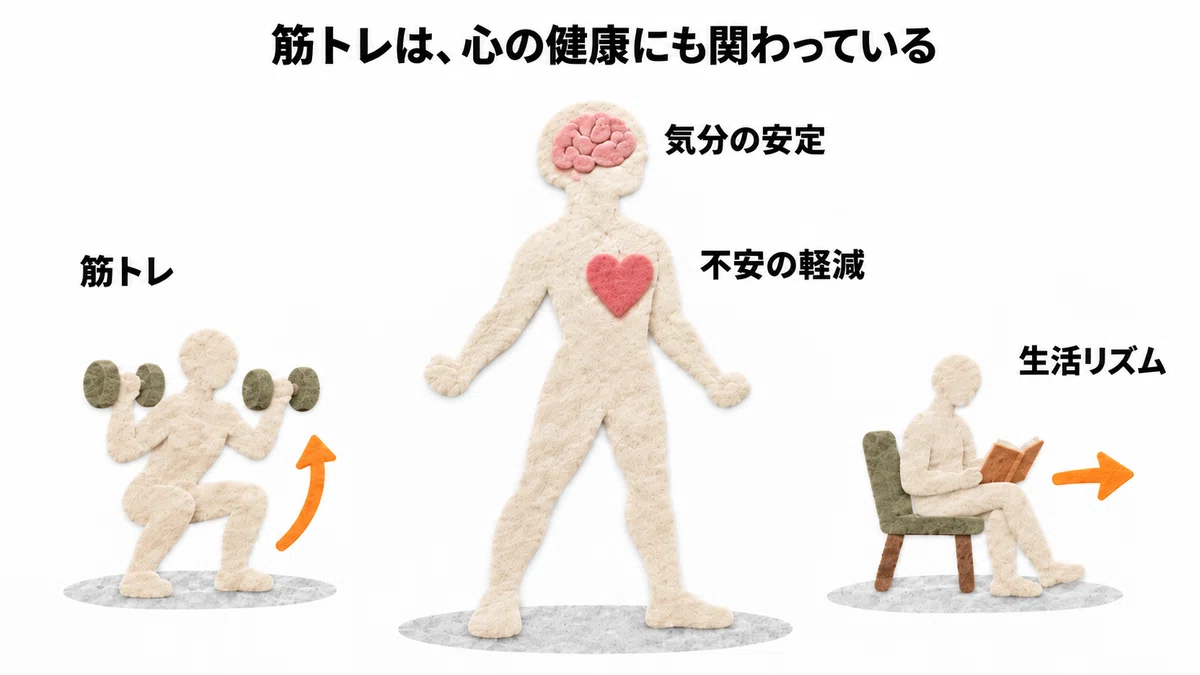
I personally feel that my mood has become more stable since I started strength training.
Research has also reported that strength training reduces symptoms of depression and anxiety.
In a 2018 study, the results of 33 trials were summarized,
confirming a moderate improvement effect on depressive symptoms.
However, in trials where the evaluators were blinded to the assignments,
the reduction in symptoms was smaller.
Also, the mechanism behind this has not been fully elucidated.
It is thought that it is not just a simple explanation of “increased happiness hormones,”
but that psychological and social factors are also involved in addition to physical stimulation.
The stability of mind I feel may also be the result of various changes accumulating.
Muscles are also involved in blood sugar regulation
Muscles have important roles beyond just moving the body.
One of these is taking up and utilizing glucose from the blood.
Normally, insulin promotes the uptake of glucose into muscles.
However, muscles also have another mechanism.
When muscles contract, glucose uptake is promoted through a pathway different from insulin.
A 2022 study, which summarized 20 trials involving adults with type 2 diabetes, found that strength training reduced HbA1c (an indicator reflecting blood sugar levels over the past 2-3 months) by an average of about 0.39 points.
While the same changes may not necessarily occur in people with normal blood sugar levels,
muscles are an important tissue that supports daily blood sugar regulation.
Moving your muscles also has the significance of supporting glucose metabolism.

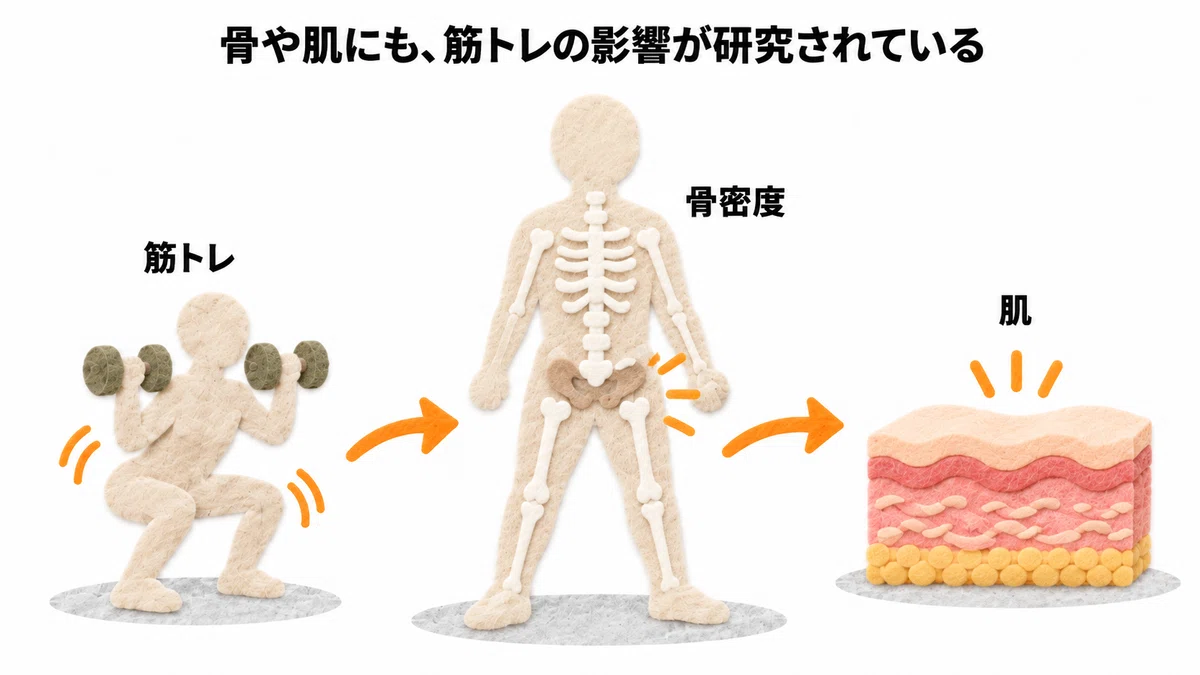
The effects of strength training on bones and skin are also being studied
It is not just muscles that receive the stimulus of strength training.
The force of muscle contraction and the load placed on the body are also transmitted to the bones.
Bones are tissues that change in response to such mechanical stimuli.
A 2025 study reported that strength training in postmenopausal women
improved bone density in areas such as the lumbar spine and hip joints, but
there is variation in research results, as improvement is not clear in some areas.
Furthermore, the relationship with skin is also being studied.
In a 16-week study of middle-aged Japanese women in 2023,
both the strength training group and the aerobic exercise group showed improvements in skin elasticity and other factors.
However, there was no comparison with a non-exercising group, and the number of participants was small.
While this is not a study that can directly explain the changes in skin radiance I feel,
it is an interesting result.
The effects of strength training may not be limited to visible muscles.
My current understanding | To live with a healthy body
The reasons for continuing strength training vary from person to person. I want to build muscle.
I want to increase the weight I lift. I want to change my appearance.
All of these are valid purposes for doing strength training.
However, as I learned more about how strength training works, I began to realize it’s about more than just that.
It supports muscle strength and physical function, and is involved in blood sugar regulation and bone health.
Mentally, it has been reported to reduce symptoms, and its relationship with skin health is also being studied.
Of course, strength training alone doesn’t solve everything.
To maintain a healthy body, diet, sleep, and daily lifestyle habits are also important.
Personally, I no longer obsess over muscle size or the amount of weight I can lift as much as I used to. Now, I value moving my body mindfully and enjoying the time spent on strength training itself.
To continue enjoying the things I love with a healthy body.
That is why I continue to do strength training.
Even if you aren’t aiming for big muscles,
I believe there are plenty of reasons to do strength training.

marumon

[References]
-
Škarabot J, et al. (2021). The knowns and unknowns of neural adaptations to resistance training. European Journal of Applied Physiology, 121, 675–685.
-
Radaelli R, et al. (2025). Effects of Resistance Training Volume on Physical Function, Lean Body Mass and Lower-Body Muscle Hypertrophy and Strength in Older Adults. Sports Medicine, 55, 167–192.
-
Gordon BR, et al. (2018). Association of Efficacy of Resistance Exercise Training With Depressive Symptoms. JAMA Psychiatry, 75, 566–576.
-
Gordon BR, et al. (2017). The Effects of Resistance Exercise Training on Anxiety. Sports Medicine, 47, 2521–2532.
-
Jansson AK, et al. (2022). Effect of resistance training on HbA1c in adults with type 2 diabetes mellitus and the moderating effect of changes in muscular strength. BMJ Open Diabetes Research & Care, 10, e002595.
-
Richter EA, et al. (2025). A comprehensive view of muscle glucose uptake: regulation by insulin, contractile activity, and exercise. Physiological Reviews, 105, 1867–1945.
-
Zhao F, et al. (2025). Optimal resistance training parameters for improving bone mineral density in postmenopausal women. Journal of Orthopaedic Surgery and Research, 20, 523.
-
Nishikori S, et al. (2023). Resistance training rejuvenates aging skin by reducing circulating inflammatory factors and enhancing dermal extracellular matrices. Scientific Reports, 13, 10214.