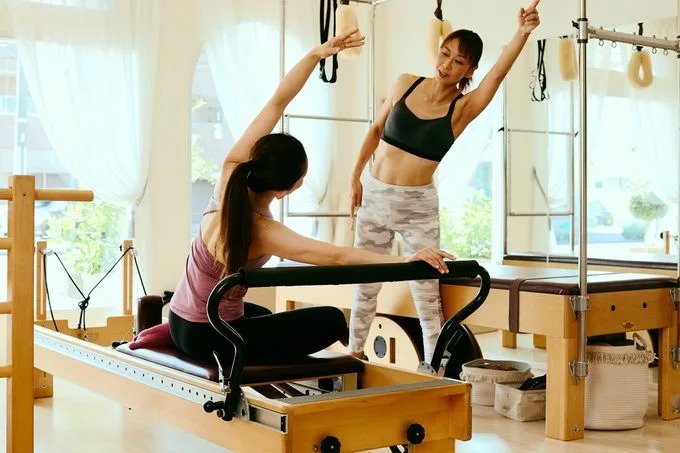
When it comes to weight loss, people often assume yoga or Pilates aren’t “challenging” enough workouts, says Marie Hiett, RD, a registered dietitian at Tufts Medicine Weight + Wellness—Stoneham in Massachusetts. In one sense, that’s true—compared to running or high-intensity workouts, they’re both less efficient at burning calories.
While having a calorie deficit is important, focusing on high-intensity workouts alone may not bring success. There are more research-backed factors for dropping pounds, and that’s where experts say yoga and Pilates can shine. Both Pilates and yoga support overall fitness in less obvious ways that could equal weight loss over a long period of time.
Ahead, experts break down the major differences between these types of workouts, how they can factor into your weight loss strategy, and other important considerations.
The unexpected ways yoga and Pilates drop pounds
The primary way to achieve weight loss is by being in a caloric deficit. Hiett explains, “A caloric deficit can be achieved by reducing food intake, increasing physical activity level to burn more calories, or using a combination of both of these methods.”
The intensity of a yoga or Pilates session can vary widely depending on the style, movements, duration, and pace. But on average, both practices burn about 200 to 300 calories per hour. That’s less than higher-intensity workouts, but that doesn’t mean they can’t support weight loss.
Yoga and Pilates can indirectly support a calorie deficit by promoting healthier behaviors, according to Hiett. “Both exercise modalities can decrease stress, which, in turn, reduces hunger cravings, bingeing, and stress-eating,” she says. These practices may also encourage mindful eating, healthier food choices, and more overall movement.
“In combination with higher intensity exercises, yoga and Pilates can be an excellent addition to a sustainable weight loss plan,” says Hiett.
How yoga and Pilates work differently
Both yoga and Pilates can support strength, muscle tone, and overall fitness.
Jenna Morris, who is a certified Pilates instructor for Club Pilates, explains the difference. She says Pilates tends to be very core-focused and controlled, while yoga can offer a wider range of options, from strength to mobility and recovery. Yoga also often includes mindfulness-based practices like breathwork, meditation, and even a degree of spirituality.
But which one is better for going down a pants size?
Pilates’ slight advantage

While neither workout is specifically designed for weight loss, Pilates may offer a small advantage when it comes to building muscle—an important factor for metabolism and body composition.
“Pilates is slightly more strength-focused than yoga,” Hiett says. “This form of exercise emphasizes the use of small, repetitive motions to build core strength and tone muscle.” That makes it moderately more effective at building muscle than yoga, and more muscle can boost your metabolism. That’s especially true when resistance is added with a Reformer, a specialized type of Pilates equipment.
At the same time, expectations matter. While Pilates can be challenging, its main goal is precision, alignment, and balance in the body—not a high-intensity, calorie-focused workout. “It will never feel like a strength-training session at the gym or a HIIT [high-intensity interval training] workout,” Morris says.
What Pilates does best is challenging multiple muscle groups at once while requiring constant core stabilization. That improves strength, posture, and movement patterns, explains Morris.
What yoga does differently

“Yoga absolutely lives on a spectrum, and that’s actually one of its strengths,” says Veronica Najera, ERYT-500 and Vice President of Education for YogaSix. Where Pilates leans more toward strength, yoga tends to support weight loss more indirectly.
More fast-paced, athletic styles of yoga can still build strength and elevate your heart rate. “But the slower formats matter just as much,” Najera explains. “They help regulate the nervous system, reduce stress, and support recovery, all of which play a role in things like hormone balance, sleep, and consistency.”
Rather than maximizing calorie burn in a single session, yoga helps reinforce the habits that make weight loss easier to maintain. It can also shift how people relate to movement. “For a lot of people, yoga becomes the thing that keeps them consistent, because it doesn’t rely on burnout or extremes to be effective,” says Najera.
The scientific key to losing weight with yoga or Pilates
Is one method better than the other when it comes to weight loss? “It really comes down to what [someone] enjoys and what they’ll stay consistent with,” says Najera. “Instead of asking ‘which burns more?’ a better question is: ‘which one helps me feel good enough to keep coming back?’”
Najera says it’s the consistency that drives the results. And research backs that up, too. A 2025 study published in the scientific journal Sensors shows that adherence to physical activity goals is one of the strongest predictors of long-term weight loss success.
How yoga and Pilates fit into weight-loss routines
Because neither is designed to burn a large number of calories on its own, experts recommend pairing them with other forms of movement. The key is how you build them into your overall routine.
Based on general physical activity guidelines, adults should aim for at least 150 to 300 minutes of moderate-intensity aerobic activity per week, plus two muscle-strengthening sessions, says Hiett. Here’s how you can fit yoga or Pilates into this framework:
-
High-intensity yoga sessions (like “power yoga”) can contribute to your aerobic activity goal.
-
Pilates sessions can count towards weekly strength sessions, especially for those who prefer low-impact resistance training.
-
Lower-intensity yoga still plays an important role in active recovery.
“Both of these workout styles can be incorporated into a weekly physical activity routine to promote weight loss and healthy habits,” Hiett says.
In this way, yoga and Pilates become less about how many calories you can burn in one go and more about building a routine you can actually stick with. And that sustainability really does matter in the long run.
For daily wellness updates, subscribe to The Healthy newsletter and follow The Healthy on Facebook and Instagram. Keep reading: